

All articles
Comparisons / 5 minutes read
Canny alternatives: Suggix vs Canny
January 27, 2026
In the process of building a SaaS product, continuously collecting user feedback, defining priorities, and maintaining a clear product roadmap are core workflows that almost every product team must deal with.
As a result, many tools have emerged to help teams manage feedback and plan roadmaps. Among them, Suggix and Canny are two products that have gained significant attention in recent years.
Although they aim to solve similar problems, they differ substantially in product positioning, feature focus, collaboration model, and pricing logic.
This article compares Suggix and Canny across multiple dimensions to help you choose the right tool based on your team size and growth stage.
Core Positioning
Suggix

Suggix is built around the idea of an end-to-end workflow from user feedback to product roadmap.
It aims to unify the following processes into a single platform:
- Collecting user feedback
- Prioritizing requests
- Converting feedback directly into actionable tasks
- Team collaboration and ownership assignment
- Roadmap planning and changelog publishing
Suggix focuses on building a closed feedback loop around user needs, avoiding the fragmentation that occurs when feedback, tasks, and roadmaps are scattered across multiple tools.
Canny
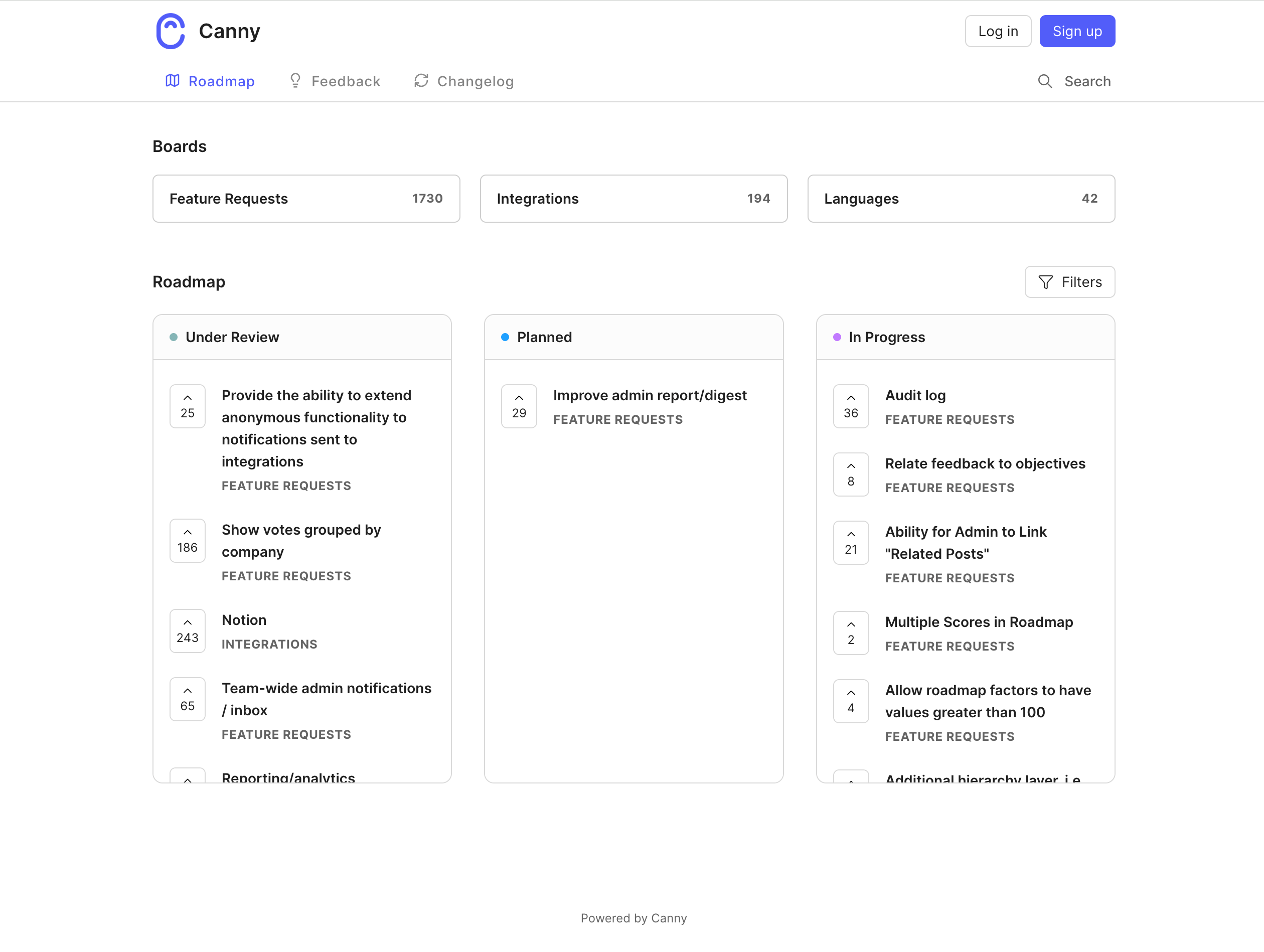
Canny is a well-established feedback management platform with a strong focus on:
- Centralized user feedback collection
- Priority setting through voting and analysis
- Increasing user engagement via public/private boards, roadmaps, and changelogs
Canny has clear advantages in market awareness, brand recognition, and third-party integrations, and is best described as a standardized enterprise-grade feedback management tool.
Suggix vs Canny: Quick Comparison
Dimension
Suggix
Canny
Product positioning
Modern feedback + task management + roadmap + changelog
Mature enterprise feedback tool
UI / Design
✨ Modern, clean, brand-customizable
More traditional enterprise style
Feedback collection
✅ Voting, comments, status
✅ Voting, comments, status
Feedback filtering
✅ Flexible, multi-dimensional
⚠️ Fewer dimensions, heavier UI
Content formatting
✅ Rich formatting (lists, images, attachments)
❌ Not supported
Task collaboration
✅ Feedback → trackable tasks
❌ Requires external tools (e.g. Jira)
Roadmap
✅ Directly tied to task status
⚠️ More manual maintenance
Changelog
✅ Notion-like editing experience
⚠️ Traditional, limited extensibility
Custom domain
✅ Yes
✅ Yes
Pricing model
💰 Fixed plans
📈 Tracked-users based pricing
Price transparency
✅ Simple and predictable
❌ Complex, scales quickly
Small team friendliness
⭐⭐⭐⭐⭐
⭐⭐
Learning curve
Low
Medium–High
Recommended Use Cases
Choose
Suggix
if you:
- Want to build a public feedback community to increase engagement and loyalty
- Need seamless integration between user feedback and internal task management
- Prefer a single, unified board instead of syncing multiple tools
- Care about transparency, ownership, and execution speed
Choose
Canny
if you:
- Want a proven feedback platform with strong brand recognition
- Rely on automated feedback processing and prioritization
- Need deep integrations with existing support or CRM systems
Pricing Comparison
(All prices are monthly equivalents billed annually)
To be fair, Canny is not “expensive” at every stage.
Its Core plan starts at $19/month, but only supports around 100 tracked users. Once you exceed that threshold, costs increase rapidly.
The real issue is not the early stage — it’s what happens once your product starts growing:
Canny pricing growth example
- Tracked users: 100 → 5,000
Core
- $19 (100 users)
- $49 (200 users)
- $525 (5,000 users)
Pro
- $49 (100 users)
- $129 (200 users)
- $1,079 (5,000 users)
Once tracked users exceed 5,000, pricing can become extremely high, with costs tightly coupled to user growth.
In practice, exceeding 100 tracked users is very easy.
At that point, Canny already becomes more expensive than Suggix — and at 5,000 users, Canny can cost dozens of times more.
In other words:
User growth itself becomes a cost multiplier.
For products in a growth phase, this is a very real and often underestimated risk.
Suggix’s Different Philosophy: Growth Shouldn’t Be “Punished”
Suggix adopts a fundamentally different pricing model:
- Start: $29 / month
- Growth: $79 / month
- Business: $199 / month
Key differences:
- No pricing based on tracked users
- Unlimited end users on all plans
- Product growth ≠ exponential cost increase
This means:
- You can promote your product without worrying about cost spikes
- The “next 100 users” won’t force a plan upgrade
- Costs remain predictable over the long term
Pricing Model Comparison
Dimension
Canny
Suggix
Pricing model
Tiered by tracked users
Fixed plans
Early stage (<100 users)
✅ Cheaper
⚠️ Slightly higher
Growth stage
❌ Costs spike
✅ Stable
Growth pressure
High
Low
Long-term suitability
⚠️
✅
Conclusion
Canny is cheaper when you haven’t grown yet.
Suggix is more sustainable when you actually start growing.
If your product is still validating ideas with a very small user base, Canny may look attractive at first. But once real growth begins, its pricing model can quickly turn user success into financial pressure.
Suggix is designed for teams that expect — and welcome — growth. By combining feedback management, task execution, and roadmap planning into a single workflow with predictable pricing, it allows teams to focus on building great products instead of worrying about rising tool costs.
If you believe growth should be encouraged rather than penalized, Suggix is built for the long run.
Related Reading
Build what users love, together
Collect feedback, prioritize features, and keep your roadmap aligned with what actually matters.
Get Started — It’s FreeNo credit card required · 14-day free trial · Setup in minutes