

All articles
Comparisons / 7 minutes read
Feedback Platform vs Help Desk System: What’s the Difference and Which One Does Your SaaS Need?
May 8, 2026
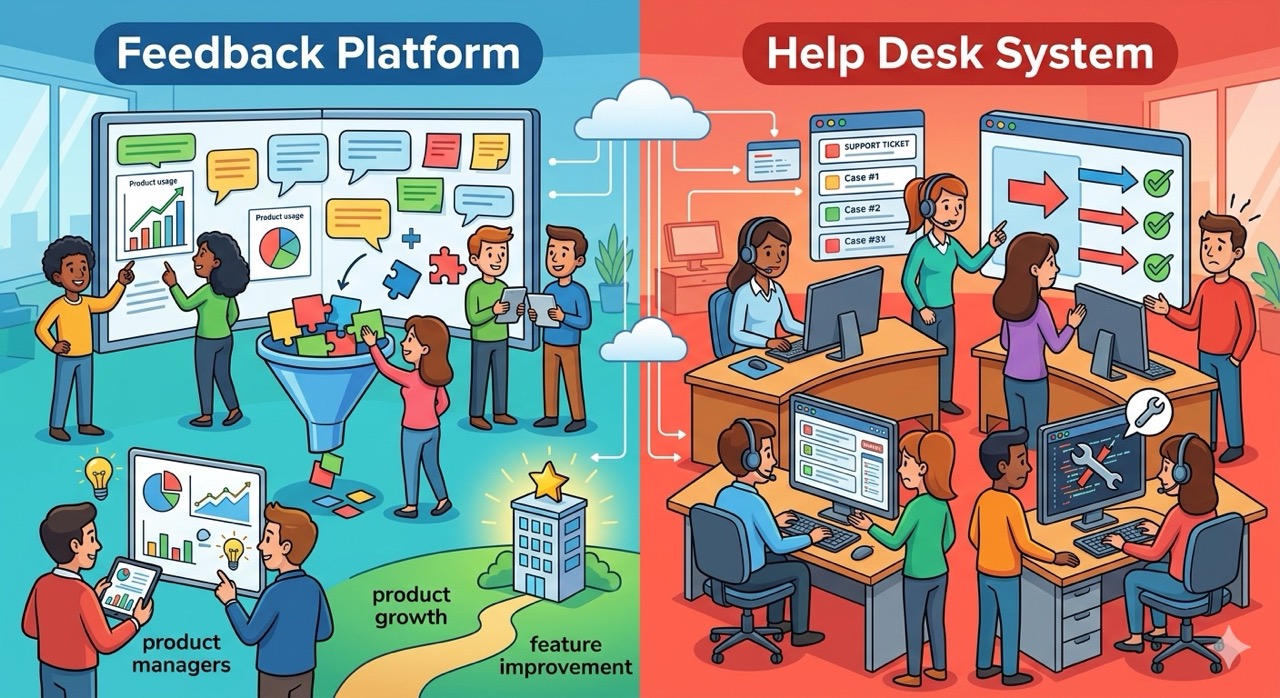
For many SaaS teams, “customer feedback” and “customer support” are treated as the same thing.
They are not.
A feedback platform and a help desk system solve fundamentally different operational problems. One helps you understand what users want next. The other helps you resolve what users need right now.
Yet companies often misuse them:
- Using support tickets as a product roadmap
- Using feature voting tools to handle urgent customer issues
- Letting valuable product insights disappear inside closed support conversations
This leads to fragmented communication, frustrated users, and reactive product development.
In this article, we’ll break down:
- What a feedback platform is
- What a help desk system is
- The key differences between them
- Pros and cons of each
- When to use one vs both
- Why modern SaaS products increasingly need both systems working together
What Is a Feedback Platform?
A feedback platform is a system designed to collect, organize, prioritize, and communicate product feedback.
Its primary goal is to help product teams answer questions like:
- What features do users want most?
- Which problems affect the largest number of customers?
- What should we build next?
- How do we keep users informed about roadmap progress?
Popular feedback platforms include tools like:
- Canny
- Productboard
- Featurebase
- UserVoice
- Suggix
Most feedback platforms include features such as:
- Feature requests
- Voting systems
- Public roadmaps
- Changelogs
- Feedback categorization
- User discussions
- Status tracking
- Product announcements
Unlike traditional support systems, feedback platforms focus on long-term product improvement rather than immediate issue resolution.
What Is a Help Desk or Ticketing System?
A help desk system (such as Zendesk or Freshdesk) is designed for customer support operations.
Its main purpose is to help support teams:
- Receive customer issues
- Track conversations
- Resolve problems efficiently
- Maintain service quality
Popular help desk tools include:
- Zendesk
- Freshdesk
- Intercom
- Help Scout
These systems are optimized for workflows like:
- Bug reports
- Billing issues
- Technical support
- Account recovery
- Refund requests
- SLA management
- Live chat
- Email support
A ticketing system is primarily operational and service-oriented.
The goal is speed, resolution, and customer support efficiency.
Core Difference: Product Discovery vs Problem Resolution
The biggest distinction is this:
Feedback Platform
Help Desk System
Focuses on product strategy
Focuses on customer support
Long-term insights
Immediate issue handling
Many-to-one discussions
One-to-one conversations
Public collaboration
Private communication
Prioritization and voting
Ticket routing and resolution
Helps decide what to build
Helps solve current problems
A support ticket asks:
“How do we fix this customer’s issue?”
A feedback platform asks:
“What should we improve for all customers?”
That difference changes everything about how the systems are designed.
Why Support Tickets Are Poor Product Roadmaps
Many early-stage startups use support inboxes as their roadmap system.
This works temporarily, but eventually breaks down.
Here’s why.
1. Duplicate Requests Become Unmanageable
When feature requests arrive through support tickets:
- The same request appears repeatedly
- There’s no centralized voting
- Demand is difficult to quantify
A feedback platform consolidates duplicate requests into one discussion.
This creates clearer prioritization signals.
2. Valuable Insights Stay Hidden
Support conversations are usually private.
That means users cannot:
- Discover existing requests
- Add additional context
- Vote on priorities
- See roadmap progress
As a result, the same conversations happen repeatedly.
3. Support Teams Become Product Managers
Without a dedicated feedback system, support agents often become manual intermediaries between users and product teams.
This creates:
- Internal bottlenecks
- Information loss
- Subjective prioritization
- Increased operational overhead
A structured feedback platform reduces this friction dramatically.
Why Feedback Platforms Cannot Replace Help Desks
The opposite mistake also happens.
Some startups attempt to use feedback boards as customer support systems.
This creates major issues.
1. Urgent Problems Need Fast Resolution
If a customer cannot log in or has a billing issue, they need direct support immediately.
They do not want to:
- Create public feature posts
- Wait for votes
- Participate in roadmap discussions
Support systems are optimized for urgency.
Feedback systems are not.
2. Many Support Conversations Are Private
Support often involves sensitive information:
- Billing details
- Security concerns
- Account access
- Internal company data
Public feedback systems are not suitable for these workflows.
3. SLA and Workflow Management Matter
Help desks provide operational tooling such as:
- Ticket assignment
- Escalation workflows
- Response time tracking
- Automation rules
- Support analytics
Feedback platforms typically lack these capabilities.
Pros and Cons of Feedback Platforms
Advantages
Better Product Prioritization
Voting and aggregation help identify high-impact requests.
Instead of relying on the loudest customer, teams gain broader visibility into demand patterns.
Increased User Engagement
Users feel heard when they can:
- Submit ideas
- Vote on features
- Track progress
- Participate in discussions
This creates stronger product-community alignment.
Transparent Product Communication
Public roadmaps and changelogs reduce uncertainty.
Users can see:
- What’s planned
- What’s in progress
- What shipped recently
Transparency builds trust.
Reduced Duplicate Requests
A centralized feedback hub prevents repeated support conversations.
Disadvantages
Weak for Urgent Support
Feedback systems are not optimized for time-sensitive problems.
Public Discussions Require Moderation
Open feedback boards can attract:
- Spam
- Duplicate posts
- Unrealistic requests
Moderation becomes necessary at scale.
Prioritization Can Be Misleading
High vote counts do not always equal business value.
Teams still need strategic judgment.
Pros and Cons of Help Desk Systems
Advantages
Fast Customer Issue Resolution
Ticketing systems excel at structured support operations.
Strong Automation
Modern help desks automate:
- Routing
- Replies
- Escalations
- Notifications
- SLA enforcement
This improves operational efficiency.
Private Communication
Sensitive customer issues can be handled securely.
Better Support Metrics
Teams can measure:
- First response time
- Resolution time
- Customer satisfaction
- Agent performance
Disadvantages
Poor Visibility Into Product Demand
Support tickets fragment feature requests across isolated conversations.
Feedback Gets Buried
Important product insights often disappear inside support queues.
Repetitive Conversations
Without a public feedback hub, users repeatedly ask for the same features.
Should SaaS Companies Use Both?
For most growing SaaS businesses, the answer is yes.
The two systems complement each other extremely well.
A common modern workflow looks like this:
Scenario
Feedback Platform
Help Desk
Billing issue
✓
Bug affecting one user
✓
Feature request
✓
Product prioritization
✓
Public roadmap updates
✓
Security issue
✓
Community discussions
✓
Customer support automation
✓
SLA management
✓
User voting and prioritization
✓
Changelog and release communication
✓
Private account-related conversations
✓
Long-term product planning
✓
Real-time issue resolution
✓
The strongest SaaS companies separate:
- Support operations
- Product discovery
- Roadmap communication
Trying to force one tool to do all three usually creates friction.
The Rise of User-Driven Product Development
Modern SaaS is shifting away from closed product planning.
Users increasingly expect:
- Transparency
- Participation
- Visibility into progress
- Faster iteration cycles
This is why public feedback platforms have become more important in recent years.
Instead of treating users as passive customers, companies now involve them directly in product evolution.
That creates:
- Better prioritization
- Stronger retention
- Increased trust
- Higher engagement
A help desk keeps customers supported.
A feedback platform helps customers feel involved.
Both matter.
Final Thoughts
A feedback platform and a help desk system are not competitors.
They solve different layers of the customer experience.
Use a help desk to:
- Resolve issues
- Provide support
- Manage operations
Use a feedback platform to:
- Discover demand
- Prioritize features
- Communicate roadmap progress
- Build a collaborative relationship with users
The most effective SaaS companies understand that support and product discovery are separate disciplines — and build systems for both.
If your team is still managing feature requests inside support tickets, it may be time to separate customer service from product strategy.
Build what users love, together
Collect feedback, prioritize features, and keep your roadmap aligned with what actually matters.
Get Started — It’s FreeNo credit card required · 14-day free trial · Setup in minutes