

All articles
Building Products / 7 minutes read
How Product Managers Turn User Feedback into a Winning Product Roadmap
March 6, 2026
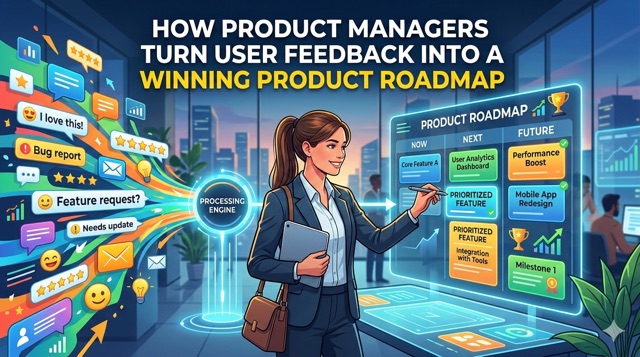
Many startups fail not because their teams lack talent, effort, or technical ability. They fail because they build the wrong things.
In the early stages of a product, founders often rely on intuition. They build features they personally believe are valuable. Sometimes they follow trends. Sometimes they copy competitors. And sometimes they simply build what seems interesting.
But there is a critical problem with this approach.
The people building the product are rarely the same people experiencing the real problem.
Without a systematic way to listen to users, teams often drift away from what actually matters. Over time, the gap between what the product team builds and what users truly need becomes wider.
This is where product management becomes essential. And at the center of modern product management is one core capability:
Turning user feedback into a clear, actionable product roadmap.
In this article, we’ll explore how successful product teams transform scattered feedback into strategic product decisions—and how tools like Suggix can help make this process far more effective.
Why Many Startups Fail to Listen to Their Users
There is a well-known statistic in the startup world: most startups fail because there is no real market need for their product.
This doesn’t necessarily mean the idea was bad. Often, it means the team simply didn’t adapt fast enough to what users actually wanted.
Early-stage products usually receive feedback from many different channels:
- Emails from users
- Feature requests in customer support
- Messages on social media
- Comments in community forums
- Conversations in Discord or Slack
- Feedback collected by sales teams
The problem is not the lack of feedback.
The problem is feedback fragmentation.
When feedback is scattered across different places, product managers struggle to answer basic questions:
- Which feature do users want the most?
- Are multiple customers asking for the same thing?
- Which request would create the biggest impact?
- What should we build next?
Without a structured system, teams end up making decisions based on the loudest voice rather than the most meaningful insight.
And that’s how roadmaps slowly drift away from real user needs.
From Random Feedback to Strategic Product Decisions
Great product teams treat feedback as a strategic asset.
Instead of reacting to every individual request, they create a process that transforms raw feedback into clear product direction.
This process usually includes four stages:
- Collect feedback
- Aggregate and organize requests
- Prioritize features
- Communicate updates to users
When these steps work together, something powerful happens.
Users feel heard.
Product teams gain clarity.
Roadmaps become aligned with real demand.
But without the right infrastructure, maintaining this loop becomes difficult—especially for small teams or fast-moving startups.
Collecting Feedback in a Structured Way
The first step toward a better roadmap is centralizing feedback.
When users have a clear place to submit feature requests or report problems, several things improve immediately:
- Feedback becomes easier to track
- Requests become visible to the entire team
- Duplicate suggestions can be merged
- Users can see existing discussions
Instead of the product team manually collecting scattered feedback, the system starts organizing itself.
This is where platforms like Suggix play an important role.
Suggix provides a dedicated space where users can:
- Submit feature requests
- Share ideas for improvements
- Report issues
- Vote on suggestions from other users
For product teams, this creates a single source of truth for user feedback.
Discovering What Users Actually Want
One of the biggest challenges in product management is separating individual opinions from real demand.
A single user may request a complex feature, but that doesn’t necessarily mean it should be built.
However, if dozens—or hundreds—of users request the same feature, the signal becomes clear.
Voting systems make this process much easier.
When users can vote on feature ideas, product managers gain valuable insight into:
- Which requests matter most
- Which problems affect the largest number of users
- Which improvements would deliver the highest impact
Instead of guessing what users want, teams can observe real demand signals.
This helps shift product development from assumption-driven to evidence-driven.
Turning Feedback into a Product Roadmap
Once feedback is organized and demand signals are visible, the next step is prioritization.
A good product roadmap balances multiple factors:
- User demand
- Business goals
- Technical feasibility
- Strategic positioning
- Development cost
User feedback is not the only factor—but it is often the most important one.
By analyzing feedback trends, product managers can identify patterns like:
- The most requested integrations
- Missing workflow features
- UX friction points
- Opportunities for automation
These insights help shape a roadmap that reflects real-world needs rather than internal assumptions.
Tools like Suggix simplify this step by allowing teams to track feedback and connect it directly to upcoming features.
When a feature moves from requested to planned, the roadmap becomes a living reflection of user needs.
Building Products With Users, Not Just for Them
One of the biggest shifts in modern SaaS development is the idea of building with users rather than simply building for them.
Users today expect transparency.
They want to know:
- What features are coming next
- Which requests are being considered
- Whether their feedback is being heard
Public roadmaps make this possible.
When product teams share their roadmap openly, several benefits appear:
- Users develop trust in the product
- Communities become more engaged
- Feedback becomes more thoughtful
- Expectations become clearer
Platforms like Suggix allow teams to publish public roadmaps directly based on collected feedback.
This creates a collaborative environment where users feel involved in shaping the product’s future.
Closing the Feedback Loop
Collecting feedback is only half the process.
The other half is closing the feedback loop.
When a requested feature is finally released, users want to know.
If teams fail to communicate updates, users may assume their feedback was ignored—even if the feature was already built.
That’s why changelogs are a crucial part of modern product management.
A well-maintained changelog allows teams to:
- Announce new features
- Highlight improvements
- Share bug fixes
- Show continuous progress
More importantly, it connects product updates back to user requests.
When users see that a feature they suggested has been implemented, something powerful happens:
They feel ownership of the product.
And engaged users often become loyal advocates.
Suggix helps automate this part of the process by linking feedback, roadmaps, and changelogs together.
When a feature ships, the people who requested it can be notified automatically.
The Feedback-Driven Product Flywheel
When feedback collection, prioritization, roadmap planning, and communication all work together, a powerful system emerges.
You can think of it as a product feedback flywheel:
- Users submit ideas
- The community votes on them
- Product managers prioritize features
- Teams build improvements
- Updates are shared through changelogs
- Users see progress and submit more feedback
Each cycle improves the product.
Each cycle strengthens user engagement.
And over time, the product evolves in the direction users actually want.
Why Feedback-Driven Products Win
The most successful products today rarely come from a single brilliant idea.
They emerge from continuous collaboration between product teams and their users.
Companies that listen carefully to feedback gain several advantages:
- Faster product-market fit
- Better feature prioritization
- Stronger user loyalty
- Higher retention
- More organic growth
Instead of guessing what to build next, teams follow signals from real users.
And this dramatically reduces the risk of building features nobody wants.

Final Thoughts
Product management is ultimately about making the right decisions under uncertainty.
There will always be competing priorities, limited resources, and difficult trade-offs.
But one thing is clear:
The best roadmap is not created in isolation. It is shaped by the people who use the product every day.
By collecting feedback, organizing requests, prioritizing features, and closing the feedback loop, product teams can transform scattered user opinions into a powerful roadmap strategy.
Tools like Suggix make this process far easier—especially for startups and small teams that need to move quickly.
Because in the end, the products that succeed are rarely the ones built purely from internal ideas.
They are the ones built together with their users.
Build what users love, together
Collect feedback, prioritize features, and keep your roadmap aligned with what actually matters.
Get Started — It’s FreeNo credit card required · 14-day free trial · Setup in minutes