

All articles
Comparisons / 5 minutes read
Productboard Pricing Explained (2026): Plans, Maker Seats, and Real Costs
May 21, 2026
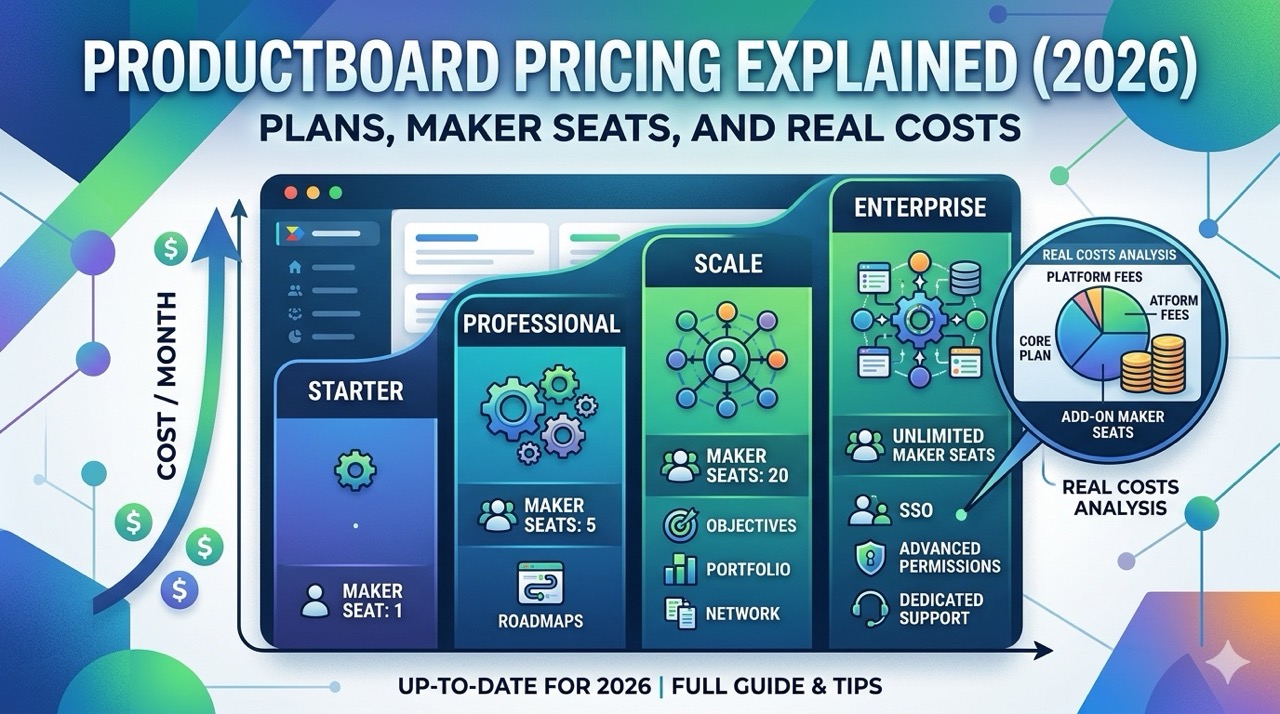
If you’re evaluating Productboard, the pricing can feel straightforward at first — until your team starts growing.
Productboard uses a per-maker pricing model, meaning costs scale based on how many people on your team need editing access. For small product teams this may look affordable initially, but costs can increase quickly once product managers, designers, researchers, support, and leadership all need access.
In this guide, we’ll break down:
- Productboard pricing plans
- What “makers” actually mean
- How pricing scales with team size
- Hidden costs and limitations
- Whether Productboard is worth it for smaller SaaS teams
- Simpler alternatives like Suggix
Productboard Pricing Plans
According to Productboard’s official pricing page, there are currently four main plans: Starter, Essentials, Pro, and Enterprise.
Plan
Pricing
Notes
Starter
Free
Limited feedback capacity
Essentials
$19/maker/month
Annual billing
Pro
$59/maker/month
Minimum 2 makers
Enterprise
Custom pricing
Contact sales
Productboard also recently introduced an AI-focused offering called Spark, priced at $15/maker/month annually.
What Is a “Maker” in Productboard?
A maker is a paid seat with editing permissions.
Makers can:
- Create and edit features
- Manage roadmaps
- Prioritize feedback
- Configure workflows
- Update product strategy
Viewers and contributors are generally free, but anyone actively managing product work usually requires a maker seat.
This pricing model works reasonably well for very small teams. The challenge appears when multiple departments need access.
For example:
- 2 PMs
- 1 designer
- 1 engineering manager
- 1 founder
- 1 researcher
That already becomes 6 maker seats.
How Productboard Pricing Scales
The biggest surprise for many teams is how quickly pricing grows.
Essentials Plan
At $19 per maker/month annually:
Makers
Monthly Cost
Annual Cost
3
$57
$684
5
$95
$1,140
10
$190
$2,280
Pro Plan
At $59 per maker/month annually:
Makers
Monthly Cost
Annual Cost
2
$118
$1,416
5
$295
$3,540
10
$590
$7,080
20
$1,180
$14,160
Pricing calculations are based on Productboard’s published pricing.
For startups and mid-sized SaaS teams, this is often where Productboard starts becoming difficult to justify.
Productboard Feature Limits by Plan
The lower tiers also include several usage limits.
Starter
- 50 feedback notes
- 1 teamspace
- 1 objective
- 1 portal
Essentials
- 250 feedback notes
- 2 automation workflows
- Limited reporting
Pro
- Unlimited feedback notes
- More automations
- Advanced reporting
- Segmentation features
Enterprise
- SSO/SAML
- Audit logs
- Salesforce integration
- SCIM provisioning
- Dedicated onboarding
For many teams, the jump from Essentials to Pro happens not because they want advanced strategy tooling, but because they outgrow the limitations.
The Hidden Cost of Per-Seat Pricing
Per-seat pricing sounds manageable initially, but it creates several operational problems as teams expand.
1. Collaboration Becomes Expensive
Product management rarely stays inside one department.
Support, sales, success, leadership, and engineering often need visibility into:
- customer feedback
- roadmap discussions
- prioritization decisions
- release planning
The more collaborative your workflow becomes, the more maker seats you typically need.
2. Annual Billing Locks Teams In
Productboard heavily incentivizes annual billing. Monthly pricing is significantly higher.
That means teams often commit before fully understanding long-term usage patterns.
3. Enterprise Features Are Paywalled
Features like:
- SSO
- advanced permissions
- audit logs
- Salesforce integration
require Enterprise plans with custom pricing.
This is common among enterprise SaaS tools, but can create budgeting uncertainty for scaling startups.
Is Productboard Worth It?
Productboard is a strong platform for:
- large product organizations
- enterprise PM workflows
- advanced prioritization systems
- structured customer research
It especially fits companies with:
- multiple PM teams
- formal roadmap governance
- dedicated operations processes
- larger software budgets
The platform is powerful, but also relatively complex compared to newer feedback tools.
For smaller SaaS teams, the biggest tradeoffs are usually:
- rising seat costs
- onboarding complexity
- overbuilt workflows
- feature fragmentation
Why Some Teams Choose Simpler Alternatives
Many startups today prefer tools that combine:
- feedback collection
- voting
- roadmap management
- changelog publishing
inside a simpler workflow with predictable pricing.
That’s part of the reason tools like Suggix are gaining traction among smaller SaaS teams.
Instead of charging per maker seat, Suggix uses fixed pricing tiers, which makes costs easier to predict as teams grow.
For example:
- feedback boards
- roadmaps
- changelogs
- internal collaboration
are included together without requiring separate seat calculations.
This tends to work well for:
- indie hackers
- startups
- small product teams
- bootstrapped SaaS companies
that want lightweight product management workflows without enterprise-level pricing.
Suggix vs Productboard Pricing Comparison (Annual Billing)
Team Size
Suggix Plan
Suggix Annual Cost
Productboard Plan
Productboard Annual Cost
Annual Savings with Suggix
Savings %
2 Makers
Starter
$348/year
Essentials
$456/year
$108/year
24%
6 Makers
Growth
$948/year
Pro
$4,248/year
$3,300/year
78%
10 Makers
Business
$2,388/year
Enterprise
Custom Pricing
—
—
Community Reactions to Productboard Pricing
Pricing concerns around Productboard appear frequently in SaaS communities.
Some founders specifically mention the difficulty of justifying per-seat costs for smaller teams.
A common theme is that many teams mainly want:
- feedback collection
- voting
- roadmap visibility
- changelog updates
without the complexity and pricing structure of enterprise PM software.
Final Thoughts
Productboard remains one of the most capable product management platforms on the market.
But its pricing model is optimized for organizations that:
- have dedicated product teams,
- operate at larger scale,
- and can justify expanding maker-seat costs over time.
For smaller SaaS companies, the real question is often not whether Productboard is powerful enough — it’s whether the workflow complexity and per-seat pricing make sense for the stage of the business.
If your team mainly needs:
- customer feedback,
- prioritization,
- public roadmaps,
- and changelog communication,
a simpler platform with predictable pricing may provide better overall value.
You can explore Productboard’s official pricing here:
Build what users love, together
Collect feedback, prioritize features, and keep your roadmap aligned with what actually matters.
Get Started — It’s FreeNo credit card required · 14-day free trial · Setup in minutes