

All articles
Building Products / 5 minutes read
SaaS Churn Rate Benchmarks (2026): What’s “Good,” What’s Dangerous, and How to Reduce It
April 10, 2026
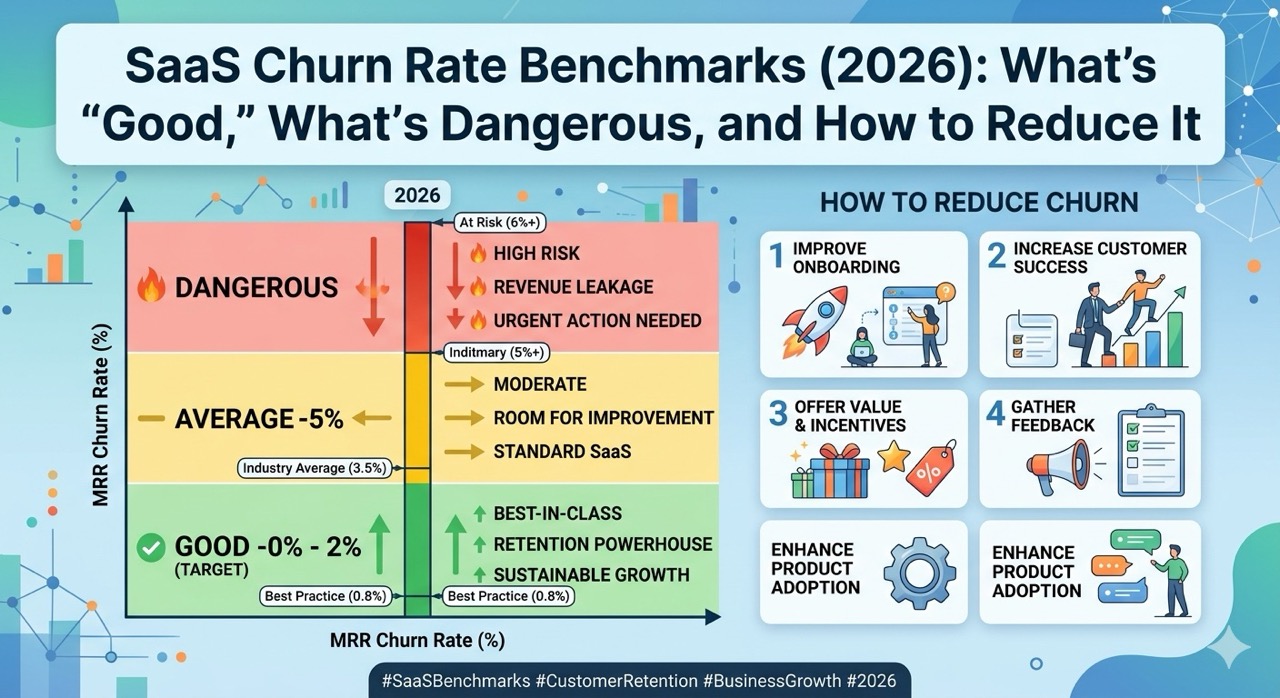
If you’re building a SaaS product, churn is the one metric that quietly determines your ceiling.
You can grow fast, acquire users, even raise funding—but if your churn is too high, your growth will eventually stall.
So the real question is:
What is a “good” churn rate in 2026—and how do you actually reduce it?
This guide breaks down real SaaS churn benchmarks, what they mean, and actionable ways to lower churn—with examples you can apply immediately.
What Is Churn Rate (and Why It Matters More Than Growth)
Churn rate is the percentage of customers who stop using (or paying for) your product over a given period.
Basic formula:
- Customer churn = Lost customers ÷ Total customers
- Revenue churn = Lost MRR ÷ Total MRR
Most early-stage founders focus on growth. But here’s the reality:
Churn compounds against you—just like interest, but in reverse.
SaaS Churn Rate Benchmarks (2026 Data)
Let’s establish a baseline.
Monthly churn benchmarks by segment
Based on aggregated industry data:
Enterprise SaaS
- 0.3% – 0.8% monthly churn
- ~4% – 9% annually
Mid-market SaaS
- 0.8% – 1.5% monthly churn
SMB / Self-serve SaaS
- 2% – 4%+ monthly churn
👉 Key insight:
The smaller the customer, the higher the churn.
What is considered a “good” churn rate?
- < 2% monthly churn → strong
- 2% – 4% → acceptable (but risky)
- > 5% → unsustainable
At 5% monthly churn, your business is effectively leaking users faster than most teams can acquire them.
The compounding effect of churn
Many founders make this mistake:
“3% monthly churn = 36% yearly churn”
Wrong.
Because churn compounds:
- 3% monthly churn → ~30.6% yearly churn
- 5% monthly churn → ~46% yearly churn
👉 Translation:
At 5% churn, you lose nearly half your customers every year.
That means you must replace 50% of your user base annually just to stay flat.
The Most Common Causes of SaaS Churn
Churn is rarely random. It’s usually structural.
1. Users never reach real value (Onboarding failure)
The majority of churn happens early:
- Most users leave within the first 30–90 days
This is not because your product lacks features.
It’s because:
Users never experience the core value.
2. You’re acquiring the wrong users
Not all growth is good growth.
Common patterns:
- Paid acquisition → higher churn
- Low-price tiers → higher churn
- Broad targeting → poor retention
👉 If users churn quickly, the issue may start before they even sign up.
3. Pricing structure drives churn
Billing cadence matters more than most teams think:
- Monthly plans churn 2–3× more than annual plans
Why?
Because monthly users constantly re-evaluate:
“Do I still need this?”
4. Users feel ignored
One of the most underestimated drivers of churn:
Users leave when they believe their feedback doesn’t matter.
Even if you’re shipping fast internally, if users don’t see it:
- They assume nothing is happening
- They disengage
- They churn
The Metric That Matters More Than Churn: NRR
Advanced SaaS companies don’t just track churn.
They track:
Net Revenue Retention (NRR)
NRR measures how your revenue changes from existing customers, including:
- Expansion (upgrades)
- Contraction (downgrades)
- Churn
Benchmarks:
- 100% NRR → flat
- 110% – 125%+ → strong SaaS performance
👉 If your NRR is above 100%:
You can grow even if some users churn.
How to Reduce Churn (Actionable Strategies)
Let’s move from theory to execution.
1. Don’t guess churn reasons—collect real feedback
Most teams assume they know why users leave.
They’re usually wrong.
Instead:
- Exit surveys
- Churn interviews
- Behavioral data
You need direct user insight, not assumptions.
2. Reduce Time-to-Value (TTV)
Your goal:
Help users achieve a meaningful outcome as fast as possible
Not “explore features”
Not “complete onboarding steps”
But:
Get a real result
The shorter your TTV, the lower your churn.
3. Improve expectation alignment
Many churn issues start with misaligned expectations:
- Marketing promises too much
- Product delivers something else
Fix this by:
- Narrow positioning
- Clear use cases
- Better onboarding messaging
4. Make users part of the product journey
Retention is not just about product quality.
It’s about user involvement.
When users feel disconnected:
- They disengage
- They churn
When users feel involved:
- They stay longer
- They invest emotionally
5. Build a continuous feedback loop
Not a one-time survey.
But an ongoing system:
- Collect feedback
- Prioritize it
- Show progress
- Close the loop
Why Most SaaS Products Fail to Fix Churn
Because they focus on the wrong levers:
- Adding more features
- Lowering prices
- Increasing ad spend
But churn is rarely solved by “more.”
It’s solved by:
Better alignment between user expectations, value delivery, and visibility
Turning Churn Into Growth: A Better Approach
The most effective SaaS companies do one thing differently:
They make users feel heard—and show them progress.
This changes everything:
- Users trust the product more
- They wait for improvements instead of leaving
- They become advocates
How Suggix Helps Reduce Churn
This is exactly the problem Suggix is built to solve.
Most tools help you collect feedback.
But they fail at the critical part:
Closing the loop with users.
Suggix focuses on turning feedback into a visible, shared process.
With Suggix, you can:
- Centralize all user feedback in one place
- Let users vote on features (prioritization becomes transparent)
- Publish a public roadmap
- Show progress updates (what’s planned, in progress, shipped)
Why this reduces churn
Because it changes user perception:
Instead of:
“This product isn’t improving.”
Users see:
“They’re actively building—and my input matters.”
That shift leads to:
- Higher retention
- Stronger engagement
- Lower churn over time
Final Thoughts
Churn is not just a metric.
It’s a signal.
It tells you:
- Whether users are getting value
- Whether expectations are aligned
- Whether they believe in your product
If you ignore churn, growth becomes fragile.
If you understand and fix it:
You build a SaaS business that compounds—predictably and sustainably.
Build what users love, together
Collect feedback, prioritize features, and keep your roadmap aligned with what actually matters.
Get Started — It’s FreeNo credit card required · 14-day free trial · Setup in minutes