

All articles
Comparisons / 8 minutes read
Codex vs Claude Code vs Antigravity: Which AI Coding Agent Is Best in 2026?
July 29, 2026
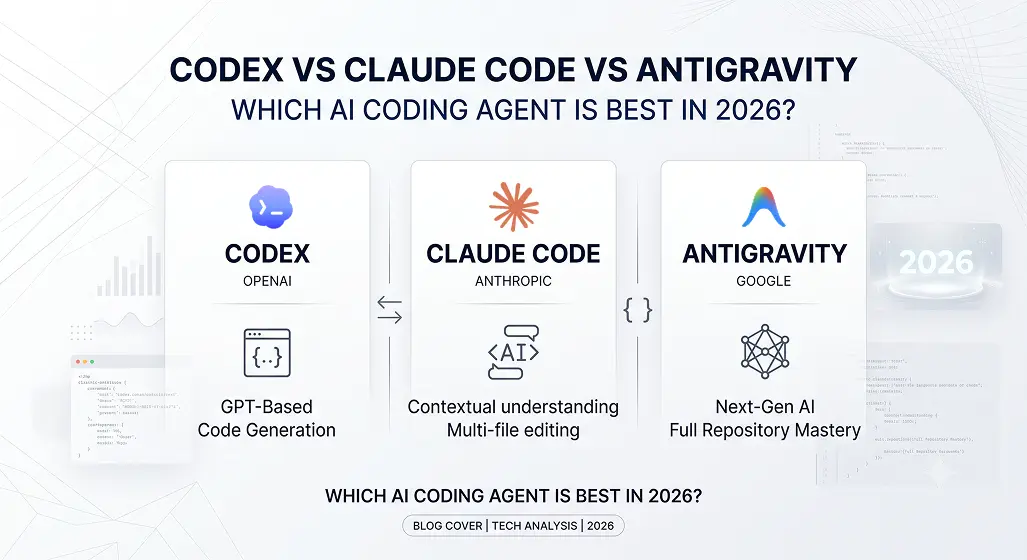
I spent the last few weeks building, debugging, and experimenting with Codex, Claude Code, and Antigravity to understand how they actually perform in real development workflows. In this comparison, I'll break down these three AI coding agents across pricing, capabilities, autonomy, and developer experience — and help you choose the right coding partner for 2026.
Quick Comparison
Category
Codex
Claude Code
Antigravity
Best For
Autonomous coding, feature development, and large-scale changes
Understanding complex codebases, debugging, and architectural decisions
Rapid prototyping and front-end focused development
Biggest Strength
Strong execution ability with minimal supervision
Deep reasoning and superior codebase understanding
Fast visual development with an agent-native IDE experience
Biggest Weakness
Sometimes requires clearer instructions to avoid over-engineering
Less autonomous workflow and can require more developer guidance
Less reliable for large, complex projects that require deep architecture understanding
Project Fit
Medium to large applications, production features, refactoring
Existing codebases, backend systems, complex software maintenance
MVPs, prototypes, UI-heavy applications
Learning Curve
Low — natural task delegation workflow
Medium — requires understanding terminal-based workflows
Low — familiar IDE experience
Recommended For
Developers who want an AI engineer that can execute tasks independently
Developers who want an AI partner that thinks through problems
Developers who want to build and iterate quickly
Codex is the strongest autonomous builder, Claude Code is the strongest engineering thinker, and Antigravity is the fastest prototyping environment.
Pricing comparison
Plan Tier
OpenAI Codex
Anthropic Claude Code
Google Antigravity
Free / Entry
$0 / month• Basic web interface only.• No Codex CLI/Agent access.
$0 / month• Web-chat only.• No Claude Code CLI access.
$0 / month (Free/Preview)• Unlimited tab completion & commands.• Access to Gemini 3.5 Flash / Claude 4.6.• Highly restricted weekly limits.
Micro / Go
$8 / month (Go)• Low token limit.• No Cloud Task Delegation.
N/A
$4.99 / month (AI Plus)• Entry-level coding allotment.• Strict weekly limits.• No Overage point top-ups.
Standard
$20 / month (Plus)• Runs default GPT-5.6 Sol.• ~10–60 cloud tasks per 5 hrs.• Hard weekly cap; drops to slow mode.
$20 / month (Pro)• Runs Claude 4.8 Sonnet / Opus.• Standard session capacity.• Weekly cap; optional pay-per-token.
$19.99 / month (AI Pro)• Runs Gemini 3 Pro / Ultra.• Standard dev quota (5-hr reset).• Weekly limit; Overage toggle to use AI credits.
Pro / Max (5x)
$100 / month (Pro 5x)• 5× more usage than Plus.• ~50–300 cloud tasks per 5 hrs.• Designed for heavy standalone freelancing.
$100 / month (Max 5x)• 5× standard session capacity.• High-frequency terminal loops.• Ideal for full-time daily programming.
$99.99 / month (Ultra 5x)• 5× higher limits than AI Pro.• Includes 20TB Cloud Storage.• Bundles free developer compute credits.
Ultimate (20x)
$200 / month (Pro 20x)• 20× more usage than Plus.• ~200–1,200 cloud tasks per 5 hrs.• Weekly caps completely removed.• For large-scale code refactoring & agents.
$200 / month (Max 20x)• 20× standard session capacity.• Maximum terminal execution speed.• Zero-throttle multi-agent pipelines.
$199.99 / month (Ultra 20x)• 20× higher limits than AI Pro.• Weekly caps completely removed.• Prioritized headless multi-agent processing.
Key Technical Differences in Limits & Costs
- Metered vs. Capped: OpenAI Codex shifted to a token-based credit pool within your subscription. This means complex tasks requiring multi-file analysis drain your 5-hour quota much faster than short tasks.
- Anthropic’s Fallback: Claude Code Pro/Max tiers enforce strict weekly thresholds. However, Anthropic gracefully allows your terminal environment to automatically switch to pay-per-token mode via an API key so you don't face sudden work stoppages.
- Google's Overage Toggle: Antigravity has a native "Overage Toggle" feature. If you burn through your base subscription's 5-hour allowance on a massive refactor, it will cleanly tap into pre-purchased or bundled AI Credits to keep running at full speed.
Official Pricing Pages
For the latest pricing, usage limits, and regional availability, refer to the official pricing pages:
- OpenAI Codex: https://chatgpt.com/codex/pricing/
- Claude: https://claude.ai/pricing
- Google AI (Antigravity): https://one.google.com/about/plans
Developer experience
OpenAI Codex: The "Brain" for Reasoning and Asynchronous Task Delegation
👍 Strengths
- Exceptional reasoning and software architecture: Built on OpenAI's reasoning model family, Codex excels at designing complex systems, implementing sophisticated algorithms, and building projects from scratch. Its code structure is typically the most rigorous, with fewer architectural mistakes and lower bug rates than most competitors.
- Powerful cloud-based asynchronous task delegation: You can hand off a complex refactoring or implementation task that might take 20 minutes, close your laptop, and let Codex complete it in the cloud. It notifies you once the task is finished, making it ideal for long-running work.
- Most mature third-party ecosystem: As one of the longest-established AI coding platforms, Codex has excellent integrations with editors such as Cursor and VS Code, along with a rich ecosystem of extensions and developer tools.
👎 Weaknesses
- Limited awareness of the local development environment: Codex primarily relies on IDE integrations rather than operating as a native CLI tool. It cannot interact with your local terminal as deeply as dedicated command-line agents, making tasks like debugging complex Docker environments or running custom Makefile workflows less seamless.
- Rigid usage quotas: Once the standard quota is exhausted within the usage window, users are throttled into a slower mode. This can become frustrating when working under tight deadlines or during intensive development sessions.
Anthropic Claude Code: The Ultimate Terminal-Native Coding Copilot
👍 Strengths
- Industry-leading long-context under: standing and large-scale refactoringClaude Code excels at understanding dependencies across large codebases. During refactors spanning dozens of files, it maintains consistency remarkably well instead of losing track of relationships between modules.
- Native terminal integration: Claude Code lives directly inside your terminal. Beyond generating code, it can execute shell commands, run test suites, inspect linter errors, and iteratively fix problems based on real execution results. This makes it feel like a true full-stack autonomous coding agent.
- Claude Code can also be configured with API access, allowing developers to continue working after subscription limits by switching to usage-based billing.
👎 Weaknesses
- Powerful permissions come with higher risk: Because Claude Code can read and modify local files as well as execute shell commands, an incorrect prompt or model hallucination may accidentally modify your Git staging area or delete files. It's strongly recommended to use it on a clean Git branch with version control.
- Steeper learning curve:The experience is heavily optimized for developers who are comfortable working in the terminal. Those who prefer polished graphical interfaces may find it less approachable.
Google Antigravity: The Fastest Path from Idea to Prototype
👍 Strengths
- Strong integration with Google's AI and cloud ecosystem
- Superior frontend design generation: Antigravity generally produces more polished, modern, and visually appealing frontend interfaces than either Codex or Claude Code, making it especially strong for UI-focused projects.
- Implementation Plan mode: Its Plan Mode automatically generates a structured implementation plan in Markdown before coding begins. Developers can review, edit, and annotate individual sections much like reviewing a design document or academic paper, making planning highly collaborative.
👎 Weaknesses
- Strong dependence on the Google ecosystem: If your infrastructure primarily runs on AWS, Azure, or non-Google tooling, many of Antigravity's advantages diminish significantly.
- Weaker software engineering discipline on large projects: Antigravity tends to jump directly into implementation instead of breaking problems into smaller milestones. It often generates very large files containing thousands of lines of code, and unlike Claude Code, it rarely asks clarifying questions when requirements are ambiguous. As a result, the first implementation may not align well with the user's actual intent, often requiring additional iterations.
As a real-world experiment, I used Antigravity to build a lightweight Pomodoro timer website from scratch in a single weekend. While it is a relatively small MVP, the process demonstrated Antigravity's strength in rapidly prototyping and validating product ideas.

Which AI coding agent should you choose?
If you're an experienced software engineer, the answer depends less on benchmark scores and more on how you work.
Choose Codex if your goal is to ship features with minimal supervision. It excels at autonomous implementation, repository-wide refactoring, and iterative execution. Its strong reasoning capabilities make it especially effective when dealing with complex changes across a large codebase.
Choose Claude Code if you spend more time understanding unfamiliar systems, reviewing architecture, or debugging difficult issues. Its ability to analyze context, explain trade-offs, and reason through complex engineering problems makes it one of the strongest choices for maintaining and evolving existing projects.
Choose Antigravity if you are building front-end-heavy applications, prototypes, or smaller projects where rapid UI iteration and visual development speed matter most. While its multi-agent workflow is interesting, it is currently less suitable for large-scale software projects that require deep repository understanding, architectural planning, and complex dependency management.
The good news is that all three represent a significant leap beyond traditional AI chatbots. Rather than simply generating code, they increasingly function as collaborative software engineers capable of planning, implementing, testing, and refining complex changes.
However, the best tool is not necessarily the one with the most automation or the most agents. For serious engineering work, the ability to understand a codebase, reason about architecture, and make reliable long-term changes remains the most important factor.
As AI coding agents continue to evolve through 2026, the real competition is no longer about who writes the best function—it's about who can understand the entire system and help engineers deliver reliable software with less effort.
Build what users love, together
Collect feedback, prioritize features, and keep your roadmap aligned with what actually matters.
Get Started — It’s FreeNo credit card required · 14-day free trial · Setup in minutes