

All articles
Building Products / 6 minutes read
Customer Feedback Management (CFM): How SaaS Teams Build Better Products with Customer Insights
July 30, 2026
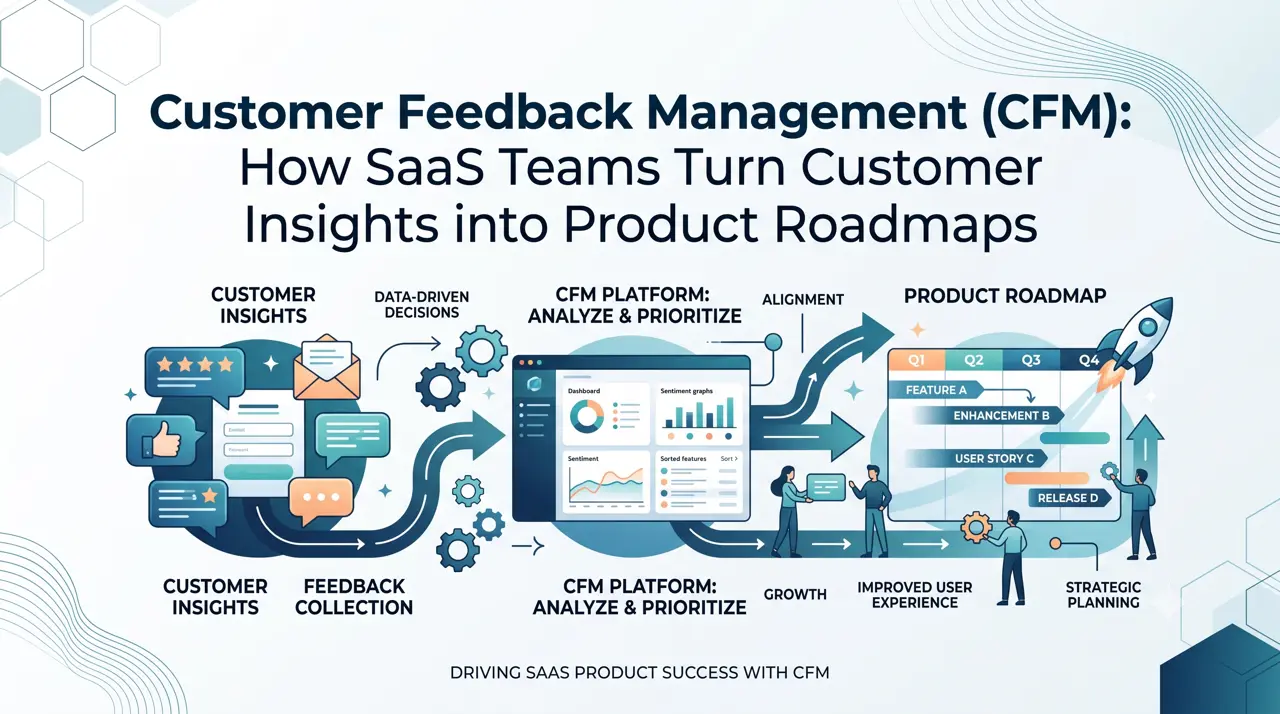
Building a successful SaaS product is no longer about simply shipping more features.
In today’s highly competitive software market, every company can build faster than ever before. AI-powered development tools have dramatically reduced the cost of writing code, prototyping, and launching MVPs. The real challenge has shifted from “Can we build it?” to “What should we build?”
This is where Customer Feedback Management (CFM) becomes a strategic advantage.
A mature SaaS company does not treat customer feedback as a collection of feature requests. Instead, it uses feedback as a continuous source of product intelligence — transforming scattered customer opinions into structured insights, prioritized roadmaps, and better product decisions.
What Is Customer Feedback Management (CFM)?
Customer Feedback Management (CFM) is the process of collecting, organizing, analyzing, and acting on customer feedback throughout the product lifecycle.
A typical CFM workflow includes:
- Collecting feedback from multiple channels
- Categorizing and analyzing customer needs
- Identifying common problems and opportunities
- Prioritizing product improvements
- Communicating roadmap decisions back to customers
For SaaS teams, feedback can come from many sources:
- In-app feedback forms
- Customer support conversations
- Sales calls
- User interviews
- Community discussions
- Feature voting platforms
- Product reviews
Without a structured system, valuable insights often disappear inside scattered emails, Slack messages, support tickets, and spreadsheets.
The problem is not a lack of feedback.
The problem is turning feedback into decisions.
Why Customer Feedback Matters More Than Ever in the AI Era
AI has changed software development fundamentally.
A few years ago, engineering capacity was often the biggest limitation for SaaS companies. Teams had to carefully choose which features to build because development resources were limited.
Today, AI coding assistants can help teams:
- Generate prototypes faster
- Automate repetitive development tasks
- Reduce implementation time
- Enable smaller teams to compete with larger companies
But this creates a new challenge:
When everyone can build faster, product judgment becomes the competitive advantage.
A SaaS company can now build ten features in the time it previously took to build three. But if those features do not solve real customer problems, faster development only creates faster waste.
Customer feedback becomes the navigation system.
AI can help you write code.
But customers tell you what deserves to exist.
From Feature Requests to Customer Problems
One of the biggest mistakes SaaS teams make is treating every feedback item as a feature request.
Example:
A customer says:
“Can you add dark mode?”
A traditional approach might add “Dark Mode” to the roadmap.
But effective feedback management asks deeper questions:
- Why does the customer want dark mode?
- Is it about visual preference?
- Is it about reducing eye strain?
- Are they using the product at night?
- Are competitors offering this experience?
The feature request is only the surface.
The underlying problem is the real insight.
A good CFM process transforms:
Customer request → Customer problem → Product opportunity
For example:
Customer Feedback
Hidden Problem
Product Opportunity
“Add export to CSV”
Users need data portability
Build better reporting tools
“Need more integrations”
Product does not fit existing workflows
Improve ecosystem strategy
“The dashboard is confusing”
Users cannot understand value quickly
Improve onboarding experience
The goal is not to build everything customers ask for.
The goal is to understand why they ask.
The Role of CFM in Product Roadmap Prioritization
A product roadmap should not be a list of the loudest customer requests.
Without structured feedback management, roadmap decisions are often influenced by:
- The biggest customer
- The most recent complaint
- The sales team’s pressure
- Internal assumptions
This creates reactive product development.
CFM introduces a more data-driven approach.
Teams can evaluate feedback based on:
Customer Impact
How many users experience this problem?
A request from one enterprise customer may be important, but a problem affecting thousands of users may deserve higher priority.
Business Value
Does solving this problem improve:
- Retention?
- Conversion?
- Expansion revenue?
- Competitive positioning?
Strategic Alignment
Does this request support the company’s long-term product direction?
A feature may be valuable but still not fit the product strategy.
Development Cost
How much engineering effort is required?
The best roadmap decisions balance impact and effort.
AI-Powered Customer Feedback Management: The Next Evolution
AI is creating a new generation of feedback management systems.
Traditional CFM tools mainly help companies collect and organize feedback.
AI-powered CFM systems can help companies understand feedback automatically.
Imagine a system that can:
Automatically categorize thousands of feedback messages
Instead of manually tagging requests:
- “Need better reports”
- “Analytics are limited”
- “Cannot track performance”
AI can recognize that they represent the same theme:
Reporting & Analytics Improvements
Detect emerging customer trends
A single complaint may not seem important.
But when AI identifies that hundreds of customers mention the same issue within a month, it becomes a product signal.
AI can help answer:
- What problems are increasing?
- Which features frustrate users?
- What competitors are customers comparing us with?
Summarize customer conversations
Product teams often spend hours reading support tickets, interviews, and sales notes.
AI can transform thousands of conversations into:
- Top customer pain points
- Feature opportunities
- User sentiment trends
- Recommended priorities
Predict feature impact
Future feedback systems may combine:
- Customer feedback data
- Usage analytics
- Churn signals
- Revenue data
to predict:
“Customers requesting this feature are 40% more likely to upgrade.”
This moves CFM from a passive feedback repository into an intelligent product decision engine.
Building a Customer-Centric Product Culture
A successful CFM strategy is not only about using the right tool.
It requires a cultural shift.
Great SaaS companies create feedback loops:
Listen → Understand → Build → Measure → Repeat
Customers should feel that their opinions matter.
This does not mean saying yes to every request.
In fact, sometimes the best product decision is saying no.
The purpose of feedback management is not to let customers design your product.
The purpose is to deeply understand customers so your team can make better decisions.
Customer Feedback Management Is the Competitive Advantage of Modern SaaS
The future of SaaS will not belong only to companies that develop the fastest.
It will belong to companies that learn the fastest.
AI has made building software easier than ever. As a result, understanding customers becomes even more valuable.
Customer Feedback Management provides the connection between customer needs and product strategy.
It transforms thousands of voices into a clear roadmap.
For SaaS teams, the question is no longer:
“Can we build this feature?”
The better question is:
“Is this the problem our customers truly need us to solve?”
The companies that answer this question better will build products that customers actually love.
Build what users love, together
Collect feedback, prioritize features, and keep your roadmap aligned with what actually matters.
Get Started — It’s FreeNo credit card required · 14-day free trial · Setup in minutes