

All articles
Building Products / 9 minutes read
ICE vs RICE vs WSJF: Which Prioritization Framework Should You Use?
July 3, 2026
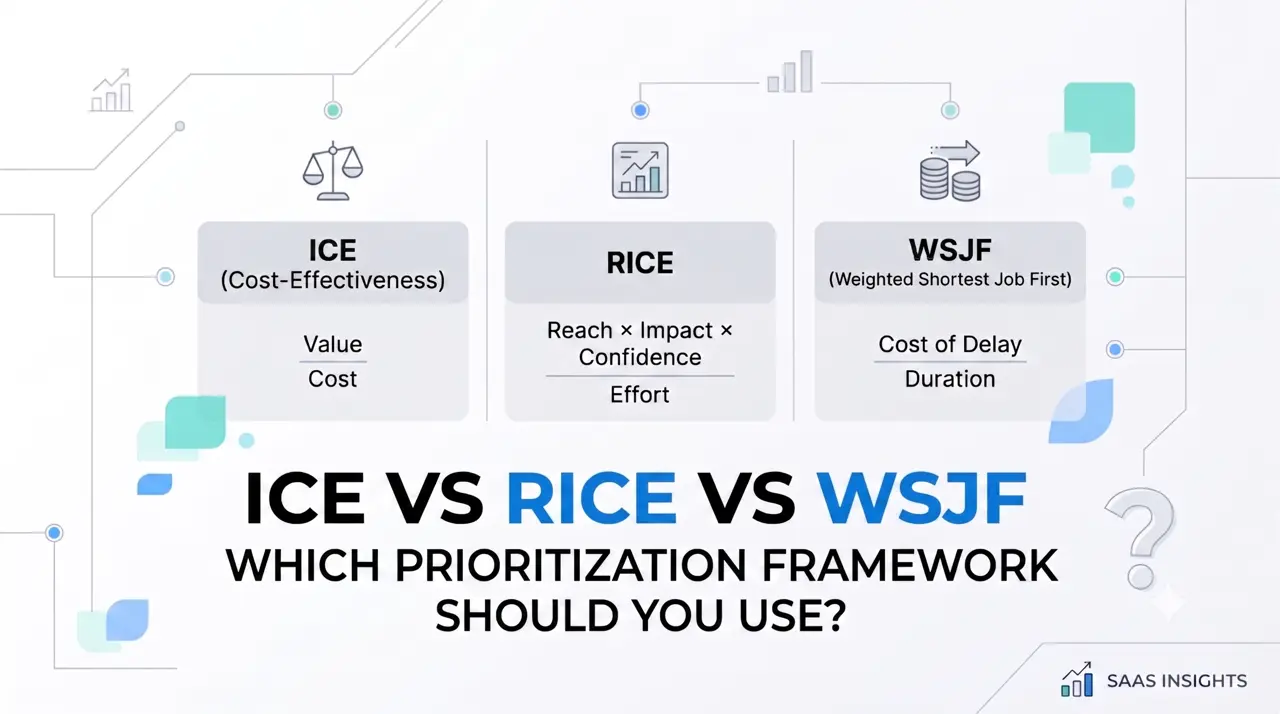
When you’re building a product, one of the hardest questions isn’t what to build—it’s what to build first.
Whether you’re a solo founder, startup team, product manager, or engineering lead, you’ll eventually face the same challenge: dozens of feature requests, bug reports, and improvement ideas competing for limited development resources.
Should you prioritize the feature that reaches the most users? The one that’s easiest to implement? Or the one that creates the biggest business impact?
This is exactly why prioritization frameworks exist.
Among the many frameworks available today, ICE, RICE, and WSJF (Weighted Shortest Job First) are three of the most popular. They all help teams make better prioritization decisions, but they’re designed for different situations and organizational maturity levels.
In this guide, we’ll compare ICE, RICE, and WSJF in depth, explain their strengths and weaknesses, show practical examples, and help you decide which framework is right for your team.
Why Prioritization Matters
Every product team has limited resources:
- Limited developer time
- Limited design capacity
- Limited budget
- Limited attention from users
Without a structured prioritization process, teams often fall into common traps:
- Building features requested by the loudest customers
- Choosing whatever seems interesting
- Constantly switching priorities
- Spending months on low-value features
- Ignoring opportunities with much higher ROI
Good prioritization frameworks reduce emotional decision-making and replace it with measurable criteria.
Instead of asking:
“What should we build?”
You ask:
“Which feature provides the highest value relative to its cost?”
Overview of the Three Frameworks
Framework
Best For
Complexity
Data Required
ICE
Early-stage startups
Very Easy
Low
RICE
Product teams
Medium
Medium
WSJF
Agile organizations
Advanced
High
Each framework solves the same problem from a different perspective.
What is ICE?
ICE is one of the simplest prioritization frameworks.
It was popularized by Sean Ellis during the growth hacking movement.
ICE scores every feature using three factors:
- Impact
- Confidence
- Ease
Formula:
ICE Score = Impact × Confidence × Ease
👉 Try Suggix’s free ICE Calculator today to prioritize your ideas.
1. Impact
How much positive effect will this feature have?
Typical scoring:
Score
Meaning
10
Massive impact
8
High impact
5
Moderate impact
2
Low impact
Examples:
- User login redesign → 6
- AI assistant → 9
- Dark mode → 4
2. Confidence
How certain are you that your estimates are correct?
Typical scale:
Score
Meaning
10
Very confident
8
Strong evidence
5
Some assumptions
2
Pure guess
If you have analytics, user interviews, or A/B test results, confidence increases.
3. Ease
How easy is the feature to build?
Higher score means easier implementation.
Example:
Feature
Ease
Change button color
10
Add notifications
6
Build recommendation engine
2
ICE Example
Feature:
Add Google Login
Scores:
Impact = 8
Confidence = 9
Ease = 8
ICE Score:
8 × 9 × 8 = 576
Another feature:
AI Chatbot
Impact = 10
Confidence = 5
Ease = 2
ICE Score:
10 × 5 × 2 = 100
Even though the chatbot has higher potential impact, Google Login becomes the higher priority because it’s much easier and more certain.
Advantages of ICE
✅ Extremely simple
✅ Fast to learn
✅ Great for startups
✅ No complicated calculations
✅ Works well with limited data
Disadvantages of ICE
ICE ignores several important factors:
- Number of users affected
- Opportunity cost
- Development duration
- Business urgency
This makes it less suitable as products grow.
What is RICE?
RICE was created by Intercom to improve upon ICE.
It introduces one important factor:
Reach
Instead of only asking how impactful a feature is, RICE also asks:
“How many users will actually experience that impact?”
Formula:
RICE Score = (Reach × Impact × Confidence) ÷ Effort
👉 Try Suggix’s free RICE Calculator today to prioritize your ideas.
RICE Components
Reach
How many users will benefit within a specific time period?
Examples:
- 100 users/month
- 2,000 users/quarter
- 50,000 page views
Unlike ICE, RICE values features that help more users.
Impact
Usually scored as:
Score
Meaning
3
Massive
2
High
1
Medium
0.5
Low
0.25
Minimal
Confidence
Usually expressed as percentages:
- 100%
- 80%
- 50%
- 20%
Effort
Measured in:
- Person-weeks
- Person-months
- Story points
Unlike ICE, effort reduces the score.
Large projects receive lower priority unless they generate enough value.
RICE Example
Feature A
Reach = 8,000 users
Impact = 2
Confidence = 90%
Effort = 4 weeks
Score:
(8000 × 2 × 0.9) ÷ 4
= 3600
Feature B
Reach = 500 users
Impact = 3
Confidence = 100%
Effort = 1 week
Score:
1500
Feature A clearly delivers more value overall.
Advantages of RICE
✅ More objective than ICE
✅ Accounts for user reach
✅ Penalizes expensive features
✅ Great for roadmap planning
✅ Widely adopted by SaaS companies
Disadvantages of RICE
Estimating Reach can be difficult.
Questions like:
- How many users will use this?
- Over what time period?
- What counts as a “user reached”?
can introduce estimation errors.
What is WSJF?
WSJF stands for Weighted Shortest Job First.
It originated from the Scaled Agile Framework (SAFe).
Unlike ICE and RICE, WSJF focuses heavily on economics.
Instead of maximizing feature value alone, WSJF maximizes Cost of Delay per unit of effort.
Formula:
WSJF = Cost of Delay ÷ Job Size
👉 Try Suggix’s free WSJF Calculator today to prioritize your ideas.
Cost of Delay
Cost of Delay is composed of three parts.
Business Value
How much value does the feature provide?
Examples:
- Revenue increase
- Customer satisfaction
- Strategic positioning
Time Criticality
What happens if we delay?
Questions include:
- Will competitors beat us?
- Is there a deadline?
- Will seasonal demand disappear?
This factor is unique to WSJF.
Risk Reduction / Opportunity Enablement
Does this feature reduce future risks?
Examples:
- Database migration
- Security improvements
- Infrastructure upgrades
These tasks may not generate immediate customer value but unlock future opportunities.
Job Size
Equivalent to development effort.
Usually estimated in:
- Story points
- Team weeks
- Relative sizing
Smaller jobs receive higher WSJF scores.
WSJF Example
Feature:
API Performance Optimization
Business Value = 8
Time Criticality = 7
Risk Reduction = 9
Cost of Delay:
8 + 7 + 9 = 24
Job Size = 6
WSJF:
24 ÷ 6 = 4.0
Another feature:
Dark Mode
Business Value = 5
Time Criticality = 2
Risk Reduction = 1
Cost of Delay = 8
Job Size = 2
WSJF = 4.0
Interestingly, both receive the same priority despite serving completely different purposes.
Advantages of WSJF
✅ Excellent for Agile teams
✅ Balances business value with urgency
✅ Considers technical debt
✅ Encourages small deliverables
✅ Strong economic foundation
Disadvantages of WSJF
It requires more organizational maturity.
Teams need:
- Good estimation skills
- Shared scoring standards
- Agile planning discipline
For small startups, WSJF may be unnecessarily complex.
Side-by-Side Comparison
Criteria
ICE
RICE
WSJF
Easy to learn
⭐⭐⭐⭐⭐
⭐⭐⭐⭐
⭐⭐
Suitable for startups
⭐⭐⭐⭐⭐
⭐⭐⭐⭐
⭐⭐
Suitable for enterprises
⭐⭐
⭐⭐⭐⭐
⭐⭐⭐⭐⭐
Includes effort
✅
✅
✅
Includes user reach
❌
✅
❌
Includes urgency
❌
❌
✅
Includes risk reduction
❌
❌
✅
Data required
Low
Medium
High
Which Framework Should You Choose?
Choose ICE if…
- You’re a solo founder.
- You’re validating an MVP.
- You don’t have much user data yet.
- You need fast decisions.
ICE is ideal for moving quickly without overthinking.
Choose RICE if…
- You have product analytics.
- You understand your users.
- Your roadmap contains dozens of competing ideas.
- You want a more data-driven process.
RICE is arguably the best all-around framework for modern SaaS products.
Choose WSJF if…
- You’re working in Agile at scale.
- Multiple engineering teams share resources.
- Technical debt is significant.
- Timing and business urgency matter.
Large organizations often prefer WSJF because it aligns engineering work with business economics.
Real-World Example
Imagine you’re building a project management SaaS. Your backlog contains four features:
Feature
ICE
RICE
WSJF
Dark Mode
Medium
Low
Low
Google Login
High
High
High
AI Task Assistant
Medium
Medium
High
Performance Optimization
Low
Medium
Very High
Notice how priorities shift depending on the framework.
- ICE favors easy wins.
- RICE favors broad user impact.
- WSJF favors strategic and time-sensitive work.
None of these rankings are inherently “correct.” The best choice depends on your product goals and constraints.
Common Mistakes When Using Prioritization Frameworks
Even with a solid framework, teams can make mistakes:
1. Treating Scores as Absolute Truth
Frameworks are decision aids, not decision makers. Use them to guide discussions, not replace judgment.
2. Ignoring Strategy
A high-scoring feature that doesn’t align with your product vision may still be the wrong choice.
3. Never Updating Scores
As you gather new customer feedback or analytics, revisit and adjust your estimates. Priorities should evolve alongside your product.
4. Overcomplicating Early Decisions
If you’re still searching for product-market fit, spending hours perfecting prioritization models can waste valuable time. Simpler methods like ICE are often enough.
Final Thoughts
There’s no universally “best” prioritization framework—only the one that best fits your team’s stage, available data, and decision-making style.
- ICE is perfect for startups that need speed and simplicity.
- RICE strikes an excellent balance between data-driven analysis and ease of use, making it a favorite among SaaS product teams.
- WSJF shines in larger Agile organizations where business value, urgency, and risk all need to be weighed against implementation effort.
Many successful companies even combine these frameworks. For example, an early-stage startup might begin with ICE, transition to RICE as user analytics mature, and adopt WSJF for large engineering initiatives or platform investments.
Ultimately, the goal isn’t to achieve a perfect score—it’s to ensure your team consistently focuses on the work that creates the greatest value for customers and the business.
If you’re looking for a practical way to apply these methods, interactive calculators for ICE, RICE, and WSJF can help you score competing ideas quickly, compare priorities side by side, and make roadmap decisions with greater confidence.
f
Build what users love, together
Collect feedback, prioritize features, and keep your roadmap aligned with what actually matters.
Get Started — It’s FreeNo credit card required · 14-day free trial · Setup in minutes