

All articles
Building Products / 8 minutes read
Stop Saying “We’re Working on It” — Show Your Product Roadmap Instead
April 24, 2026
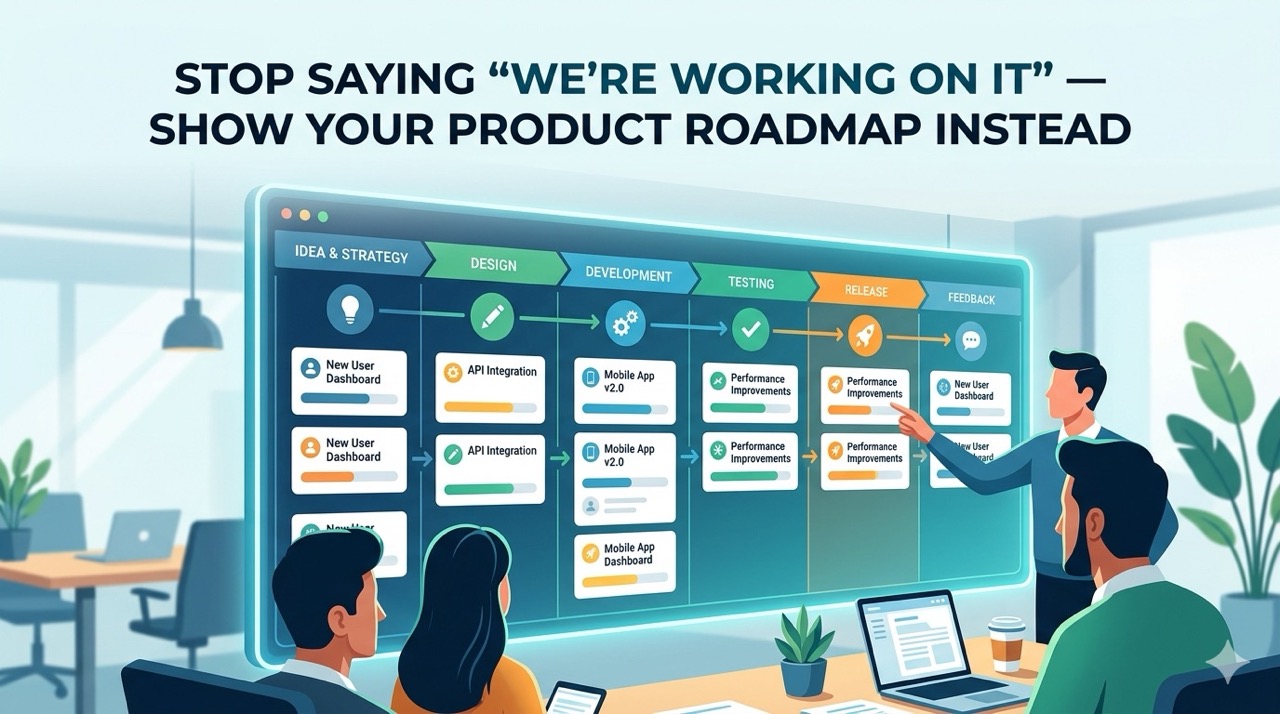
“We’re working on it.”
If you’ve built any product—especially as a small team or solo developer—you’ve probably typed that sentence more times than you can count. It shows up in emails, support chats, Twitter replies, Discord threads, and customer interviews.
And every time you say it, it quietly fails to do what you think it does.
It doesn’t reassure users.
It doesn’t build trust.
It doesn’t reduce support load.
And most importantly—it doesn’t scale.
What it actually does is create ambiguity.
Users don’t know:
- What exactly is being worked on
- How important their request is
- When it might be delivered
- Whether it’s even aligned with your roadmap
So they ask again. And again. And again.
At some point, they stop asking—and they leave.
This is where most teams misunderstand the problem. They think it’s a communication issue. It’s not. It’s a visibility issue.
And the solution isn’t to respond faster.
It’s to stop saying it—and start showing it.
The Real Cost of “We’re Working on It”
Let’s break down what actually happens behind that phrase.
1. Repetitive, Low-Leverage Communication
Every time a user asks about a feature:
- You explain the same thing
- In slightly different words
- Across multiple channels
This is operationally expensive. Not in money—but in focus.
You’re burning time on communication that:
- Doesn’t compound
- Doesn’t scale
- Doesn’t improve over time
For small teams, this is especially painful. You don’t have a dedicated support team. Every interruption pulls you away from building.
2. Fragmented Product Management
Most teams use:
- One tool for task management (e.g. Jira, Linear)
- One for documentation (Notion)
- One for communication (Slack, email)
- One for feedback (if at all)
Now think about what happens when a user asks for an update:
- You check your internal tool
- Translate internal context into user-friendly language
- Send a manual response
This translation layer is pure overhead.
Worse, your internal state and external communication drift apart over time.
3. Misalignment Between What You Build and What Users Want
Without structured feedback:
- Loud users dominate decisions
- Silent users churn quietly
- Assumptions replace data
You might think you’re building the “next important feature,” but in reality, you’re solving a problem that only a small fraction of users care about.
This is how teams spend weeks building something that gets ignored.
4. Lack of Trust and Momentum
From a user’s perspective:
- “We’re working on it” feels vague
- It feels like a placeholder, not a commitment
- It doesn’t create anticipation
Users don’t need perfection.
They need progress they can see.
If they can’t see it, they assume it’s not happening.
The Shift: From Replies to Transparency
Instead of replying individually, what if:
- Every feature request had a status
- Every task had a visible owner
- Every update was publicly tracked
- Every user could see what’s next
That’s the difference between:
Saying “we’re working on it”
and
Showing a living roadmap
This is where a tool like Suggix fundamentally changes the workflow—not by adding complexity, but by removing layers.
A Single System That Serves Both Teams and Users
At its core, the idea is simple:
The same system you use to manage your product internally should also serve as your external communication layer.
With Suggix, when you collect feedback, you’re not just storing ideas—you’re creating actionable, structured work items.
Each piece of feedback can be:
- Assigned a status (planned, in progress, completed)
- Prioritized based on votes and impact
- Given a clear owner
- Scheduled with a due date
This already replaces a large part of your internal planning process.
But here’s the key difference:
Everything is visible to users.
Pain Point #1: Bridging Internal Planning and External Trust
Traditionally:
- Internal tools = private
- User communication = manual
With Suggix:
- Internal planning = external transparency
When users submit feedback:
- They can track its status in real time
- They see when it’s picked up
- They know who’s working on it
- They understand where it sits in the priority stack
This creates a powerful effect:
Even if the feature isn’t ready yet, users can see progress.
And that changes behavior dramatically.
Instead of leaving, users think:
- “They’re actually building this”
- “It’s coming soon”
- “I’ll wait”
You’re not just managing expectations—you’re creating anticipation.
Pain Point #2: Reducing Tool Fragmentation
Instead of juggling multiple systems:
- Feedback tool
- Task manager
- Roadmap document
- Status updates
You consolidate into one flow:
- Feedback is submitted
- It becomes a task
- It gets prioritized
- It gets assigned
- It gets shipped
- It gets marked as completed
No duplication. No translation. No syncing.
This reduces:
- Context switching
- Manual updates
- Miscommunication
And most importantly—it gives you back time to focus on building.
Pain Point #3: Letting Users Define Direction
One of the most underestimated signals in product development is user voting.
When users can:
- Upvote features
- Comment on ideas
- Signal demand collectively
You start to see patterns:
- Which problems matter most
- Which ideas are niche
- Where your assumptions are wrong
This creates a feedback loop:
- Users influence priorities
- You ship based on real demand
- Users feel heard
- Engagement increases
And when you adjust direction based on this data, you avoid a critical mistake:
Building deeply in the wrong direction.
Pain Point #4: Scaling Communication Without Scaling Effort
For solo developers and small teams, this is a game changer.
Instead of:
- Answering the same question 20 times
- Writing custom updates for each user
- Managing expectations manually
You simply say:
“You can track it on the roadmap.”
That’s it.
No explanation needed.
Users self-serve:
- They check status
- They follow updates
- They subscribe to changes
You’ve effectively turned communication into a system, not a task.
Additional Benefits You Might Not Expect
1. Built-in Accountability
When tasks are public:
- Deadlines matter more
- Ownership is visible
- Progress is harder to ignore
This naturally improves execution discipline.
2. Marketing Without Marketing
Your roadmap becomes:
- A content stream
- A progress log
- A story of your product evolving
Users—and even potential users—can see:
- What you’re building
- How fast you’re moving
- What you care about
This builds credibility without traditional marketing.
3. Better Product Narrative
Instead of random feature releases, your product tells a story:
- “We listened to this feedback”
- “We prioritized it”
- “We shipped it”
That narrative is powerful. It shows responsiveness and intentionality.
4. Retention Through Visibility
Users don’t churn just because features are missing.
They churn when:
- They feel ignored
- They see no progress
- They lose confidence
A transparent roadmap directly addresses all three.
Why This Matters More for Small Teams
Large companies can afford:
- Dedicated support teams
- Product managers
- Customer success roles
Small teams can’t.
You need leverage.
Transparency is leverage.
It allows you to:
- Communicate once, serve many
- Build trust without constant interaction
- Scale your presence without scaling headcount
Practical Implementation (with Suggix in real use)
If you’re considering this approach, the transition is usually straightforward:
Start collecting feedback in one place. Convert feedback into structured tasks. Define clear statuses. Make the board public. Let users follow updates and vote.
That’s enough to get started.
In practice, this is where Suggix fits in as a unified layer rather than just a feedback tool. Instead of treating feedback as isolated messages, every submission becomes a structured item that flows through your product process.
For example, when a user requests a missing feature, it doesn’t stay as a static note. It enters your system and becomes part of your execution flow. Internally, you can track it through Suggix’s feedback system here: https://www.suggix.com/features/feedback.
From there, it naturally connects to your product workflow where you can assign ownership, set priorities, and manage delivery:
Once organized, these items are reflected directly in a public roadmap so users can see what is planned and what is already in progress:
When something is shipped, it can be documented through a changelog so progress is continuously visible without manual communication:
The key difference is that users are no longer relying on repeated explanations or “we’re working on it” replies. They can see the status themselves, follow changes, and understand where their request stands at any time.
That’s it.
You don’t need a complex process. You need a system where feedback, execution, and communication are naturally connected instead of manually synchronized.
Final Thought
“We’re working on it” is not wrong.
It’s just incomplete.
In a world where users expect transparency, speed, and clarity, words are no longer enough.
You need visibility.
Because the moment users can see progress:
- Trust increases
- Patience increases
- Engagement increases
And that’s the difference between a product people try—and a product people stick with.
So stop saying it.
Show it.
Related Reading
Build what users love, together
Collect feedback, prioritize features, and keep your roadmap aligned with what actually matters.
Get Started — It’s FreeNo credit card required · 14-day free trial · Setup in minutes