

All articles
Building Products / 10 minutes read
The AI-Era SaaS Growth Guide:Part I — The New SaaS Growth Landscape
May 15, 2026
The SaaS industry is entering a new era.
For more than a decade, SaaS growth followed a relatively predictable playbook: build useful software, rank on Google, run paid ads, optimize onboarding, and gradually scale through recurring subscriptions. Companies that executed well on distribution and product quality could maintain a competitive edge for years.
That model is changing rapidly.
Artificial intelligence is reshaping how software is built, how users interact with products, and how SaaS companies compete. AI is not simply another feature category; it is fundamentally changing the economics of software businesses. Engineering barriers are lower than ever, product iteration cycles are dramatically faster, and user expectations are evolving at a pace the SaaS industry has never experienced before.
At the same time, the internet has become far more competitive. Distribution channels are saturated, customer acquisition costs continue rising, and differentiation is increasingly difficult to sustain. Modern SaaS companies are no longer competing only on features—they are competing on speed, workflow integration, trust, and user experience.
This guide explores how the SaaS growth landscape is evolving in the AI era and what modern SaaS companies must do differently to survive and grow.
Why SaaS Growth Is Changing in the AI Era
The traditional SaaS market was built around “software as a tool.” Users opened an application, manually performed tasks, and used the software to improve efficiency.
AI changes this relationship entirely.
Modern software is increasingly becoming an intelligent collaborator rather than a passive tool. Instead of simply providing interfaces and dashboards, AI-powered products can now generate content, automate workflows, analyze data, make recommendations, and even take actions autonomously.
This shift changes user expectations dramatically.
Users no longer compare your product only against direct competitors. They compare it against the growing standard of AI-native experiences established by products like OpenAI, Notion, Figma, and Linear.
They expect:
- Faster onboarding
- Smarter workflows
- Personalized experiences
- Natural language interfaces
- Automation by default
- Reduced manual work
As a result, SaaS companies that still rely on slow-moving feature development and traditional UX patterns are beginning to feel outdated.
The Shift From Traditional SaaS to AI-Powered SaaS
Traditional SaaS products were primarily systems of record. Their core value came from storing, organizing, and displaying information.
Examples included:
- CRM systems
- Project management tools
- Analytics dashboards
- Knowledge bases
- Ticketing systems
AI-powered SaaS products are evolving into systems of intelligence.
Instead of simply storing data, modern SaaS platforms actively help users make decisions and complete work. The software layer is becoming increasingly proactive rather than reactive.
This transition introduces a major strategic shift:
the value of software is moving away from interfaces and toward outcomes.
Users care less about how many buttons or features a product has. They care more about whether the product helps them achieve results faster.
For example:
- An AI customer support platform is judged by how effectively it resolves tickets.
- An AI writing tool is judged by content quality and speed.
- An AI analytics platform is judged by the quality of insights it produces.
This creates enormous pressure on SaaS companies because feature parity now happens extremely quickly.
The Core Challenges Modern SaaS Companies Face
Rising Customer Acquisition Costs (CAC)
One of the biggest problems facing SaaS companies today is distribution saturation.
Search engines are crowded with AI-generated content. Paid advertising costs continue increasing. Organic social reach is becoming less predictable. Traditional growth channels that once worked efficiently are now significantly more competitive.
Many SaaS startups discover that building the product is no longer the hardest part—getting attention is.
AI has dramatically reduced the cost of building software, which means more competitors can enter nearly every market category. As supply increases, acquiring users becomes more expensive.
This creates a dangerous imbalance:
software production costs are decreasing while distribution costs are increasing.
Faster Competition
AI accelerates iteration speed across the entire industry.
A feature that once took six months to build can now be replicated in weeks or even days. Open-source models, AI coding assistants, and low-code tooling have significantly reduced engineering friction.
As a result:
- Product advantages disappear faster
- Market categories become crowded more quickly
- Smaller teams can challenge established incumbents
This means SaaS companies cannot rely solely on shipping features to maintain an advantage anymore.
Execution speed matters, but positioning, ecosystem integration, and user loyalty matter even more.
Shorter Differentiation Cycles
Historically, a successful SaaS feature could remain differentiated for years.
Today, AI compresses that timeline dramatically.
When every competitor can integrate similar AI capabilities using the same foundation models, differentiation based purely on technology becomes fragile. Many AI products risk becoming interchangeable “wrappers” around the same infrastructure.
This is why sustainable SaaS companies increasingly focus on:
- Workflow integration
- Proprietary data
- User communities
- Brand trust
- Superior UX
- Distribution advantages
In the AI era, defensibility comes less from raw functionality and more from ecosystem depth and user relationships.
AI-Native User Expectations
A new generation of users expects software to behave intelligently by default.
Users increasingly expect:
- Search that understands intent
- Context-aware recommendations
- AI-assisted writing
- Automated categorization
- Predictive workflows
- Conversational interfaces
Static dashboards and manual workflows feel increasingly outdated.
This creates pressure on SaaS companies to rethink product design from the ground up. Adding an AI chatbot to an old product is rarely enough. Users expect AI to be embedded deeply into workflows rather than treated as a superficial add-on.
How AI Is Reshaping SaaS Growth
AI is not only changing products—it is changing the mechanics of growth itself.
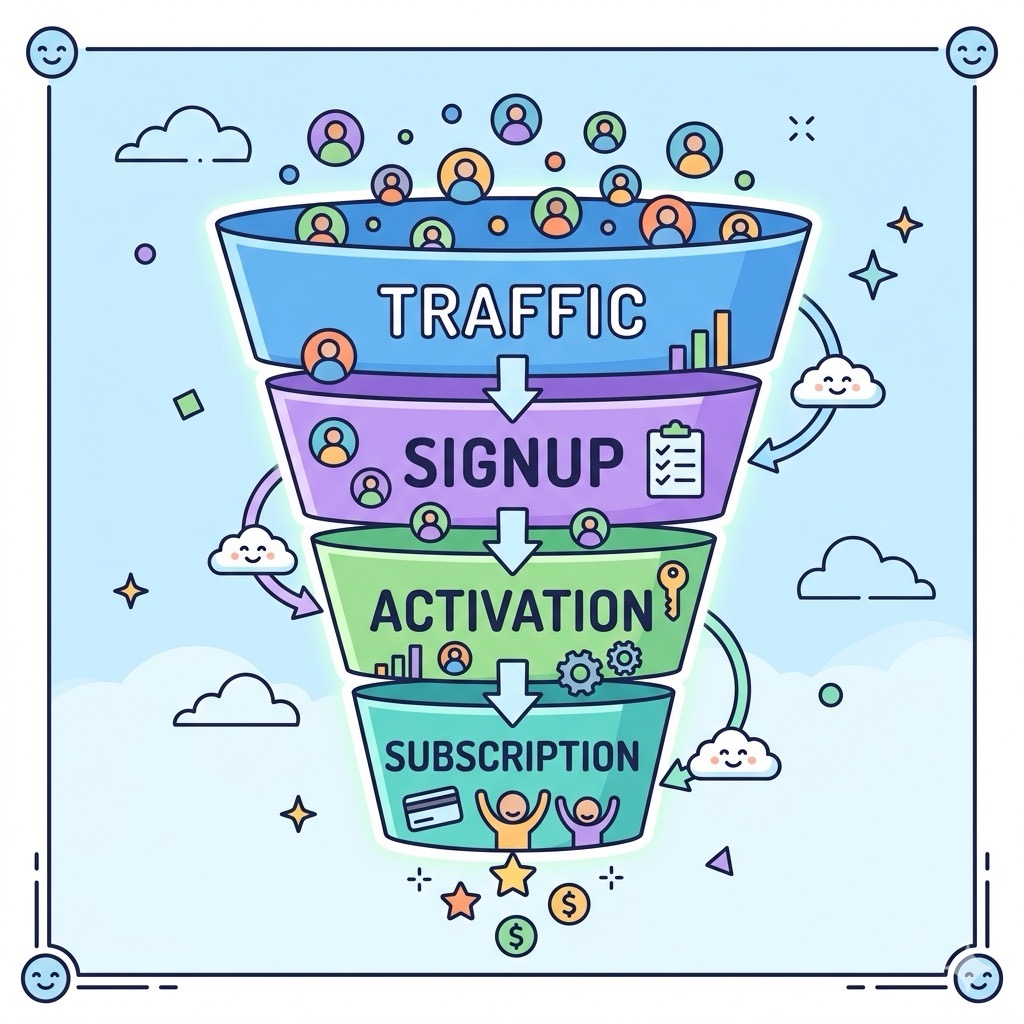
The traditional SaaS growth playbook relied heavily on linear funnels:
traffic → signup → activation → subscription.
That model is becoming less effective because modern growth is increasingly nonlinear and experience-driven.
From Software Tools to Intelligent Systems
The most important transformation happening in SaaS is the evolution from passive tools into intelligent systems.
Traditional SaaS required users to operate the software manually.
AI-native SaaS products increasingly:
- Suggest actions
- Automate repetitive tasks
- Generate outputs
- Predict user intent
- Coordinate workflows
This changes the relationship between users and software. Products are becoming collaborative systems rather than utilities.
Companies that successfully embrace this transition create significantly stronger retention because users become dependent on the product’s intelligence layer, not just its database.
Why Feature Advantages Disappear Faster Than Ever
AI democratizes implementation.
Once a successful workflow becomes visible, competitors can reproduce similar functionality rapidly using existing models and APIs. This compresses competitive timelines across nearly every SaaS category.
As a result, sustainable advantages now come from:
- Brand credibility
- Distribution
- Data advantages
- Workflow depth
- User trust
- Ecosystem lock-in
The best SaaS companies no longer win simply by shipping features first. They win by building systems users do not want to leave.
AI Lowers Engineering Barriers but Increases Distribution Competition
AI coding tools have made product development dramatically faster.
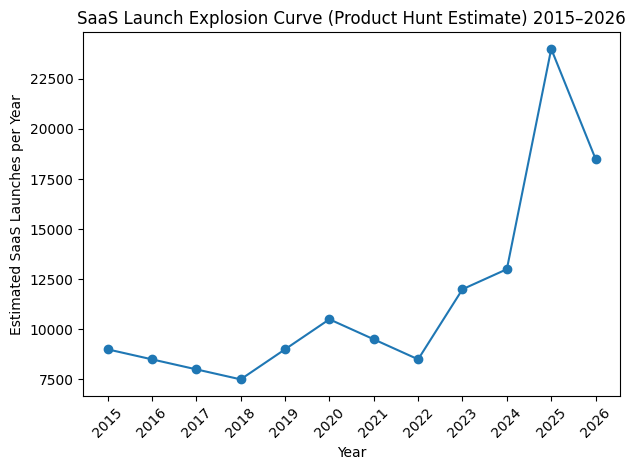
Small teams can now build sophisticated products with fewer engineers. This is creating an explosion of new SaaS products across almost every category.
However, easier product creation produces a second-order effect:
distribution becomes the primary bottleneck.
The future winners in SaaS are unlikely to be the companies with the most features. They are more likely to be the companies with:
- Strong positioning
- Clear messaging
- Trusted brands
- Loyal communities
- Deep customer understanding
In other words, marketing and product strategy are becoming even more important in the AI era—not less.
The Rise of AI Copilots and Agentic Workflows
Modern SaaS products are increasingly shifting toward copilots and autonomous workflows.
Instead of users manually executing every action, AI systems can:
- Draft responses
- Summarize information
- Analyze trends
- Coordinate tasks
- Trigger workflows automatically
This transition fundamentally changes SaaS UX design.
The best products reduce cognitive load rather than simply adding functionality. Users increasingly value software that simplifies decisions and removes operational friction.
The companies that understand this shift early will build significantly stronger product adoption.
Why User Trust and Product Experience Matter More Than Ever
As AI-generated products flood the market, trust becomes increasingly valuable.
Users are becoming more skeptical of generic AI experiences, inaccurate outputs, and low-quality automation. This creates a major opportunity for SaaS companies that prioritize reliability, transparency, and user experience.
In the AI era:
- Trust is a growth strategy
- UX is a competitive moat
- Transparency improves retention
- Feedback loops improve product quality
Users stay with products they trust—not just products with impressive demos.
The New Growth Formula for SaaS
The AI era is changing how SaaS growth works at a fundamental level.
Traditional SaaS growth focused heavily on acquisition:
more traffic, more signups, more leads.
Modern SaaS growth increasingly depends on retention, engagement, and network effects.
Traditional Growth Models vs AI-Era Growth Models
Traditional SaaS growth prioritized:
- SEO traffic
- Paid acquisition
- Sales funnels
- Lead generation
- Feature expansion
AI-era SaaS growth prioritizes:
- Product experience
- Workflow integration
- Retention loops
- User collaboration
- Community and trust
- Rapid iteration
This is a critical mindset shift.
Growth is no longer just about acquiring users—it is about building products users continuously rely on.
Product-Led Growth (PLG) in an AI-First World
Product-led growth becomes even more powerful in the AI era because users expect immediate value.
Modern users want:
- Instant onboarding
- Self-serve adoption
- Fast time-to-value
- Minimal friction
AI can accelerate activation dramatically by helping users achieve meaningful outcomes faster.
The best AI SaaS products reduce the gap between signup and success.
Community-Driven and Feedback-Driven Growth
Modern SaaS companies can no longer build products in isolation.
Users increasingly expect transparency, visibility, and influence over product direction. Public roadmaps, changelogs, feedback boards, and community engagement are becoming growth mechanisms themselves.
Community-driven growth creates:
- Stronger loyalty
- Better retention
- Faster iteration
- Organic advocacy
The strongest SaaS brands increasingly treat users as collaborators rather than customers.
Building Growth Loops Instead of Funnels
Funnels are linear.
Growth loops are compounding.
Traditional funnels end after conversion. Growth loops continuously generate new engagement and acquisition through existing users.
Examples include:
- Collaboration invites
- Shared workspaces
- Public templates
- User-generated content
- Referral systems
- Community participation
AI-powered SaaS products that successfully embed collaborative workflows can create extremely durable growth engines.
Why Retention Matters More Than Acquisition
In crowded SaaS markets, retention is becoming the ultimate competitive advantage.
Acquisition is expensive.
Retention compounds.
Products with strong retention:
- Reduce CAC pressure
- Increase LTV
- Improve word-of-mouth growth
- Generate expansion revenue
- Build stronger communities
The future of SaaS growth belongs to companies that build products users continuously return to—not products users merely try once.
Conclusion
The SaaS industry is entering one of the biggest transitions in its history.
AI is lowering barriers to creation while simultaneously increasing competitive pressure. Features alone are no longer enough. Distribution is harder. User expectations are higher. Differentiation cycles are shorter.
But this new environment also creates enormous opportunities.
The next generation of successful SaaS companies will not simply build software—they will build intelligent systems, trusted brands, and deeply integrated workflows that users depend on every day.
In Part II of this guide, we will explore how modern SaaS companies can build AI-native products that create sustainable competitive advantages in this rapidly evolving landscape.
Related Reading
Build what users love, together
Collect feedback, prioritize features, and keep your roadmap aligned with what actually matters.
Get Started — It’s FreeNo credit card required · 14-day free trial · Setup in minutes