

All articles
Comparisons / 8 minutes read
Jira vs Suggix: Which Feature Request & User Feedback Tool Is Better in 2026?
June 26, 2026
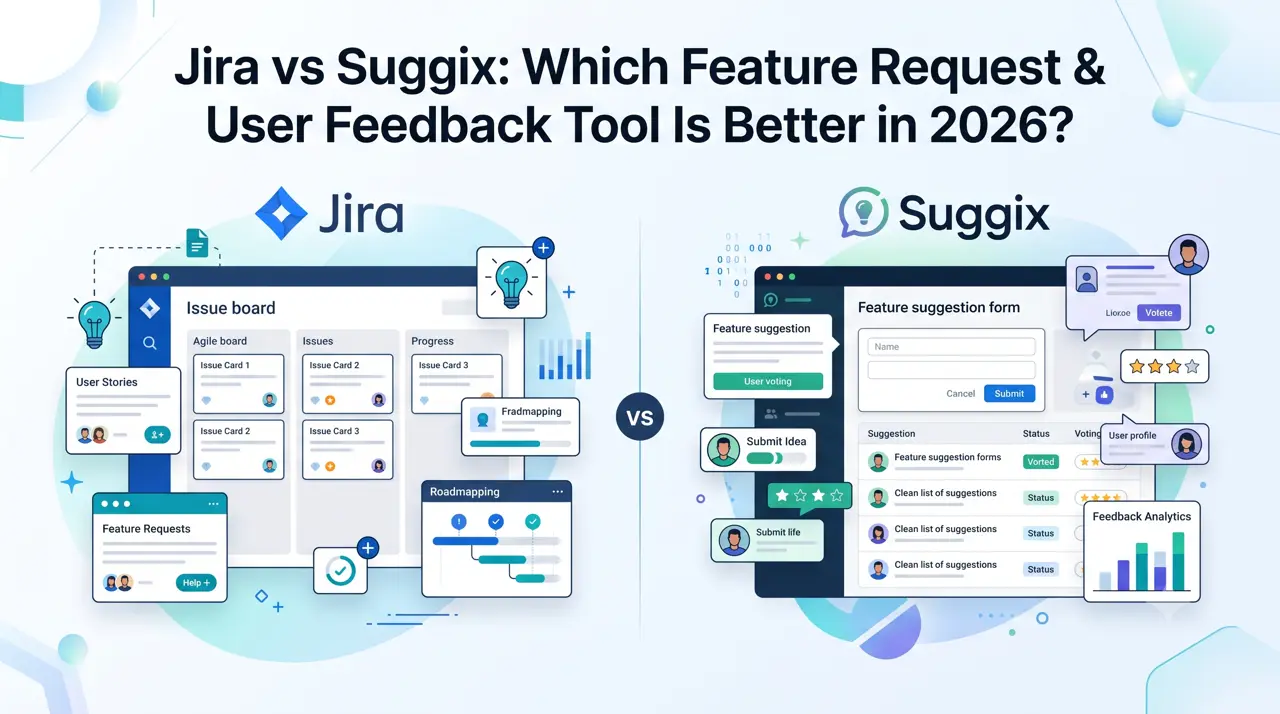
When people think about product management software, Jira is usually one of the first names that comes to mind. For years, it has been the go-to platform for software development teams managing bugs, sprint planning, and agile workflows.
However, building a successful product today requires much more than internal issue tracking. Modern SaaS companies need to collect customer feedback, prioritize feature requests, publish transparent roadmaps, announce product updates, and keep users engaged throughout the product lifecycle.
This shift has led many product teams to search for a Jira alternative specifically designed for customer feedback management rather than engineering workflows.
That’s where Suggix comes in.
While Jira excels at helping developers organize work, Suggix focuses on connecting customers with product teams. It combines feature requests, voting, roadmaps, changelogs, and user communication into a single platform.
In this guide, we’ll compare Jira and Suggix across every important category to help you decide which tool best fits your team in 2026.
What is Jira?
Jira is an issue tracking and project management platform developed by Atlassian. Originally designed for software engineering teams, Jira has become one of the most widely used tools for agile development.
Its core strengths include:
- Sprint planning
- Scrum and Kanban boards
- Issue tracking
- Bug reporting
- Workflow automation
- Release management
- Developer collaboration
Engineering teams love Jira because it offers incredible flexibility. Almost every workflow can be customized, making it suitable for organizations of every size.
However, Jira was never designed to be a customer-facing feedback platform.
Although customers can technically submit requests through Jira Service Management or external forms, the experience is often disconnected from the actual product management workflow.
For companies trying to build products around customer feedback, this usually means adding multiple additional tools.
What is Suggix?
Suggix is a modern product feedback platform built specifically for SaaS companies and product teams.
Instead of focusing on internal engineering tasks, Suggix helps businesses create a transparent feedback ecosystem where customers can:
- Submit feature requests
- Vote on existing ideas
- Leave comments
- Follow feature progress
- View public roadmaps
- Read product changelogs
- Receive notifications when features ship
For product managers, Suggix centralizes customer insights into one place, making prioritization much easier.
Instead of maintaining spreadsheets, emails, support tickets, and Slack messages separately, every piece of feedback becomes structured and searchable.
The result is a tighter feedback loop between users and product teams.
Feature Comparison
Although both platforms contribute to product development, they solve different problems.
Feature
Jira
Suggix
Issue Tracking
✅ Excellent
❌
Sprint Planning
✅
❌
Bug Management
✅
Limited
Customer Feedback
Limited
✅ Excellent
Feature Requests
Basic
✅
Feature Voting
❌
✅
Public Roadmap
Limited
✅
Changelog
Limited
✅
User Notifications
Limited
✅
Customer Portal
Basic
✅
Jira manages engineering execution.
Suggix manages customer communication.
Many successful SaaS companies actually use both together.
Customers submit ideas in Suggix.
Product managers prioritize requests.
Approved features are synchronized into Jira for engineering implementation.
Customer Feedback Experience
One of the biggest differences between Jira and Suggix is the customer experience.
With Jira, customers rarely interact directly with the platform.
Instead, feedback often arrives through:
- Support tickets
- Emails
- Slack
- Intercom
- Zendesk
- Google Forms
The product team then manually copies information into Jira.
This process creates several problems:
- Duplicate requests
- Lost context
- No visibility for customers
- Difficult prioritization
- Repeated support conversations
Suggix solves these problems by allowing customers to participate directly.
Users can search existing ideas before submitting new ones.
They can upvote features they care about instead of creating duplicates.
Comments become centralized.
Everyone can follow feature progress without contacting support repeatedly.
This creates a self-service feedback portal that reduces support workload while improving customer satisfaction.
Feature Voting
Not every customer request deserves equal priority.
One customer asking for a feature may not justify months of engineering work.
However, when hundreds of customers vote for the same request, product managers gain valuable validation.
This is where feature voting becomes essential.
Jira doesn’t provide built-in community voting for product ideas.
Teams often rely on:
- Google Forms
- Productboard
- Trello
- Canny
- UserVoice
or custom-built solutions.
Suggix includes feature voting from the start.
Users can:
- Vote
- Remove votes
- Comment
- Follow requests
- Receive updates
Votes become one of several signals product managers can use when deciding what to build next.
Combined with qualitative feedback, customer segments, and business goals, voting helps teams prioritize more confidently.
Public Roadmaps
Transparency builds trust.
Customers appreciate knowing whether a feature is:
- Planned
- In Progress
- Under Review
- Completed
Unfortunately, Jira roadmaps are designed primarily for internal planning.
Sharing them publicly is often impractical because they contain engineering details, internal tickets, and confidential information.
Suggix offers public roadmaps specifically designed for customers.
Product teams can organize features into categories such as:
- Planned
- In Progress
- Released
Each roadmap item can include:
- Description
- Progress
- Comments
- Linked feature requests
- Release information
Customers gain visibility without exposing sensitive internal development data.
Changelog & Release Notes
Shipping features isn’t enough.
Customers also need to discover what has changed.
Many companies spend months building valuable features only to see low adoption because users never realize they exist.
Jira records releases for developers but isn’t designed as a public changelog.
Suggix includes an integrated changelog system where teams can publish:
- New features
- Improvements
- Bug fixes
- Performance updates
- Announcements
Each release can automatically notify interested users.
This closes the feedback loop:
Customer request → Product development → Release announcement
Keeping customers informed increases feature adoption while reinforcing that user feedback truly matters.
Pricing
Pricing is often one of the biggest factors when choosing a product management or customer feedback platform. While Jira and Suggix serve different purposes, comparing their pricing helps illustrate the value each platform provides.
Jira Pricing
Jira uses a per-user pricing model, making it an excellent choice for engineering teams of all sizes.
Plan
Starting Price
Free
Up to 10 users
Standard
From $8.60 per user/month
Premium
From $17 per user/month
Enterprise
Custom pricing
As teams grow, the monthly subscription increases because every additional user requires a paid seat. Organizations also frequently subscribe to other Atlassian products—such as Confluence or Jira Service Management—which can further increase the total cost of ownership.
Suggix Pricing
Suggix uses a straightforward team-based pricing model with a fixed number of included seats, making costs more predictable for growing SaaS businesses.
Plan
Monthly Price
Included Seats
Starter
$29/month
2 seats
Growth
$79/month
6 seats
Business
$199/month
10 seats
Every Suggix plan includes the core functionality needed to manage customer feedback, including feature requests, voting, public roadmaps, and changelogs.
Unlike many project management platforms, Suggix pricing is designed around product teams rather than engineering headcount.
Which Offers Better Value?
The better value depends on what you’re trying to solve.
If your primary need is software development, sprint planning, and issue tracking, Jira offers excellent value with its flexible per-user pricing and mature engineering ecosystem.
If your goal is to build a customer-driven product, Suggix provides a dedicated feedback platform without requiring multiple specialized tools. Instead of paying separately for feature request software, voting tools, public roadmaps, and changelog solutions, Suggix combines these capabilities into a single product with transparent pricing.
For many SaaS companies, the decision isn’t Jira or Suggix—it’s Jira for engineering execution and Suggix for customer feedback management.
Pros & Cons
Jira
Pros
- Industry-leading issue tracking
- Powerful workflow automation
- Excellent agile support
- Mature ecosystem
- Extensive integrations
- Highly customizable
Cons
- Not customer-focused
- No native feature voting
- Public roadmap limitations
- Complex setup
- Steeper learning curve
- Customer feedback scattered across multiple tools
Suggix
Pros
- Built specifically for customer feedback
- Integrated feature requests
- Public voting
- Public roadmaps
- Built-in changelog
- Better customer engagement
- Transparent product communication
- Easy to use
Cons
- Not intended to replace engineering project management
- Limited sprint planning features
- Best used alongside development tools like Jira
When Should You Choose Jira?
Choose Jira if:
- Your primary challenge is software development.
- You need advanced sprint planning.
- Your engineering team follows Scrum or Kanban.
- You require sophisticated issue tracking.
- Workflow customization is a top priority.
Jira remains one of the strongest project management tools available for engineering organizations.
When Should You Choose Suggix?
Choose Suggix if:
- You want to collect customer feedback.
- Your users frequently request new features.
- You need feature voting.
- You want a public roadmap.
- You publish product updates regularly.
- Customer engagement is a strategic priority.
- You want customers to see how their feedback influences product decisions.
Suggix helps product-led companies build stronger relationships with their users through transparency and continuous communication.
Final Verdict
Jira and Suggix are not direct competitors—they solve different stages of the product development process.
Jira is built for managing how software gets built. It excels at engineering execution, issue tracking, sprint planning, and development workflows.
Suggix is built for managing what should be built next. It gives customers a voice through feature requests, voting, public roadmaps, and changelogs, while providing product managers with the insights needed to prioritize work more effectively.
For many modern SaaS teams, the best approach isn’t choosing one over the other—it’s using both together. Customers submit ideas and track progress in Suggix, while developers implement approved work in Jira. This creates a seamless feedback loop from user suggestion to shipped feature.
If your biggest challenge is organizing engineering work, Jira remains one of the best choices available. But if your goal is to become more customer-driven, increase transparency, and build products based on real user demand, Suggix is the stronger choice.
As customer expectations continue to evolve in 2026, companies that actively listen, communicate openly, and involve users throughout the product lifecycle will be better positioned to build products people truly love.
Build what users love, together
Collect feedback, prioritize features, and keep your roadmap aligned with what actually matters.
Get Started — It’s FreeNo credit card required · 14-day free trial · Setup in minutes